
Staff Rides: Mike Kazimer’s Specialized Chisel FS

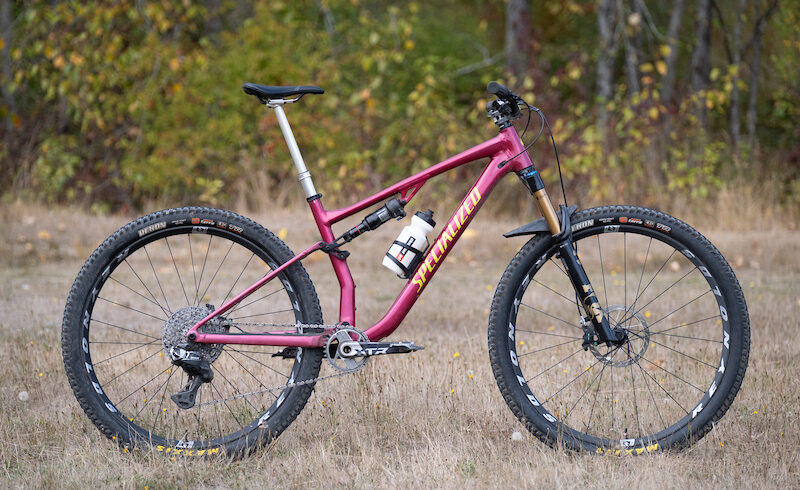
Mike Kazimer’s Specialized Chisel FS
It took a little while, but the geometry changes that swept through the trail and enduro categories finally reached the shortest travel options, which means that sketchy handling is no longer the norm for cross-country bikes. The ideal XC machine is still much lighter and more maneuverable than a big enduro sled, but the revised geometry and modern components allow them to be ridden much harder than their predecessors.
• Travel: 110mm rear / 130mm fork
• Wheel size: 29″
• Frame construction: aluminum
• 66° head angle, 437mm chainstays
• Weight: 27.8 lb / 12.6 kg (size L without pedals)
• specialized.com
I’ve been using the aluminum-framed Specialized Chisel FS for over a year as a testing platform for the various XC-oriented products that show up for review. It’s my hot lap machine, a palate cleanser of sorts from the 40 pound enduro sleds that keep rolling in, as well as the bike that I’ll grab for longer jaunts that cover lots of ground.
Frame
The Chisel has 110mm of travel courtesy of a 190 x 40mm stroke shock and a flex-stay suspension layout. My size large frame with thru-axle weighed in at 2920 grams, lending credence to Specailized’s claim that this is the lightest aluminum XC frame on the market – options from competitors like Trek or Scott are in the 3,200 gram range.
With the 130mm fork that I’m currently running the Chisel’s head angle sits at 66-degrees, and the reach measures 465mm. Those numbers are very similar to the Norco Revolver 130 that I also have in for testing – the biggest geometry differences between those two bikes are the chainstay lengths (437mm for the Chisel and 430mm for the Revolver), and the stack (624mm on the Chisel and 611mm on the S3 Revolver). I’ll have a more in-depth comparison once that Revolver review is finished, but at the moment it’s been fun being able to switch between the two to suss out the differences.
Weight
This Chisel FS has gone through multiple build configurations – at one point I had it down to 26 pounds thanks to some ridiculously light Roval carbon wheels. Lately, it’s been hovering in the 27 – 28.5 pound range depending on what I’m running for wheels and tires.
As shown, it weighs in at 27.8 pounds (size L, no pedals). That’s nearly 3 pounds heavier than what World Cup racers are sprinting around on, but it’s almost over 10 pounds lighter than those aforementioned chunky enduro sleds. Plus, that weight is with a 36mm stanchion fork, four-piston brakes, and a 200mm dropper post.
Suspension
At various points the Chisel has had a 120mm Manitou R8, a 110mm RockShox SID SL, and it’s now sporting a 130mm Fox 36 SL. Specialized sells an EVO version of the Chisel that has a 130mm fork, so I decided to see what it was like for myself. As it turns out, it’s great. The concept of an XC bike with a 36 on it still seems sort of ridiculous, that is until you try it out. The extra stiffness that comes from those larger diameter stanchions it noticeable, and helps bump up the capability of the bike as a whole. For the record, I don’t have any complaints about the stiffness of a 34, SID, or R8 – they’re appropriately stiff for XC usage. That SID SL was a little too flexy for my tastes – on chattery descents I could feel more front end movement than I wanted.
The 36 SL is 265 grams heavier than the 34 SL, so riders who are watching their bike’s weight will want to keep that in mind. For this build, I was going for more of a cross-country goof-off machine rather than an all-out race bike, so those extra grams didn’t bother me.
For my 160 lb weight I’m running 75 psi, 9 clicks of LSC, 8 clicks of HSC, and 7 clicks of rebound, all counted from closed.
I’m still running the stock RockShox Deluxe shock inflated to 220 psi, mainly because there hasn’t really been any reason to swap it out – the tune is firm without being too harsh, and there’s enough ramp-up to keep the bike from blowing through all 110mm of travel on bigger hits.
Tires / Wheels
The Chisel FS has been set up with multiple different tire and wheel combos over the last year, everything from the ridiculously light Specialized Roval Control SL Team carbon wheels with to Hunt’s budget-friendly XC Wide MTB wheelsets.
It currently has Reynold’s new 309 XC Expert carbon wheels mounted up with 2.4” Maxxis Rekons at 20 / 22 psi. The wheels are reasonably light at 1419 grams, but I have been noticing some spoke noises on my first few rides – I can hear the rear wheel loading and unloading under hard pedaling, resulting in a ‘ting, ting’ sound. I need to investigate a little further – it may be something as simple as increasing the tension, or they could just be noisy wheels.
I also have another wheelset in for review, FSA’s SCi30 carbon all-mountain wheelset. With a $1,250 price tag and a claimed weight of 1495 grams the wheels looked intriguing on paper, but the actual weight of 1655 grams isn’t quite as impressive. I have those wheels mounted with WTB’s Peacekeeper tires – in that configuration the Chisel becomes a bit more of a short travel trail bike.
Brakes
When I first built up the Chisel I ran SRAM Code brakes, in part because that’s what I had on hand, and also because I wasn’t a fan of the Level 4-piston brakes at all. Luckily those Levels have left the building, and the new Motives are a much better option. They do have a little less power than Codes, but on a lighter weight XC or trail bike they’ll do the trick. I’m running 180mm rotors front and rear with metallic pads, and there’s enough stopping power on tap even when I end up on not-exactly-XC terrain.
Those Reynolds wheels have centerlock hubs, which I’d normally avoid (I prefer 6-bolt), but I did happen to have two fancy titanium centerlock rotor lockrings from Josh Ogle, so it was a good excuse to add a little unnecessary bling to this build.
Drivetrain
For the drivetrain, I went with Shimano’s new XTR wireless electronic drivetrain with a 9-45 tooth cassette and short cage rear derailleur. I like the shift speed and shifter ergonomics of Shimano’s new wireless groups, and the battery lasts a very, very long time, but the chainslap can be quite loud with the longer cage derailleur. Instead of a clutch, the derailleurs use a strong dual spring system, which can make quite a racket when it gets pulled forward and slaps backward on rough trails. The noise level is much more tolerable with the shorter cage derailleur, since there’s less chain flapping around when the cage moves back and forth.
I’m running 170mm cranks with a 32-tooth chainring to go along with the 9-45 tooth cassette. That gives me an easy enough climbing gear for the steep logging roads around my home, but I’d want something even easier if I was slogging around on a heavier bike. In that case a 30-tooth chainring would be the ticket.
Contact Points
I’ve never been a huge fan of traditional XC cockpit setups – long stems and flat bars may be the ideal for max wattage and climbing efficiency, but my focus is more on fun than FTP. To that end, I’m running a PNW Components 40mm stem and a 38mm rise bar trimmed down to 760mm. I was a little concerned that 40mm would be too twitchy, but it’s working well, and the overall fit is nice and comfortable.
I’m running a PNW Components Loam Dropper V2 with 200mm of drop; that’s more than you’ll typically find on an XC race bike, since most race courses don’t have terrain that necessitates that much travel, and in a race scenario you wouldn’t want to be moving your seat up and down all the way very often. For me, I’ll take the extra drop, since it gets the seat out of the way when I decide to drop into something silly and steep.
Speaking of comfort, I’m running Peaty’s Monarch thin lock-on grips to keep my hands happy, and a WTB Solano SL saddle to keep my undercarriage happy. Those components are a matter of personal preference, but I’m a fan.
How’s It Ride?
The Chisel FS isn’t a super slack enduro bike, and that’s why I like it. There’s a limit to what it can do, which forces me to focus a little more in the techy bits rather than just letting off the brakes and letting it run. With less travel to play with precision is the name of the game – pick the right line and you’ll be rewarded, get sloppy and you’ll get bounced around like those suckers who decide that riding a mechanical bull in a crowded bar at two o’clock in the morning is a good idea.
There’s a good deal of support from the rear suspension for standing up and pedaling hard, and the bike responds well on rolling terrain. There’s a pump track that I ride by on many of my rides, and when I’m on the Chisel it’s hard to resist pulling in for a few laps. Fast and fun is the name of the game here, and that’s why I won’t be taking the Chisel out of the rotation any time soon.
First Appeared on
Source link