
$300 GeForce vs. $300 Radeon GPU: Four Generations, Head to Head

For years, the $300 graphics card has been the heart of PC gaming. It’s the price point where performance meets accessibility, where budget-conscious gamers can expect a taste of high-end features without breaking the bank. But over the past several GPU generations, that sweet spot has grown stale.
We have often criticized both GPU makers for dragging their feet here, offering minimal performance gains and few compelling upgrades, but the latest generation shows some of the best gains we have seen in years, which is a positive sign for budget gamers.
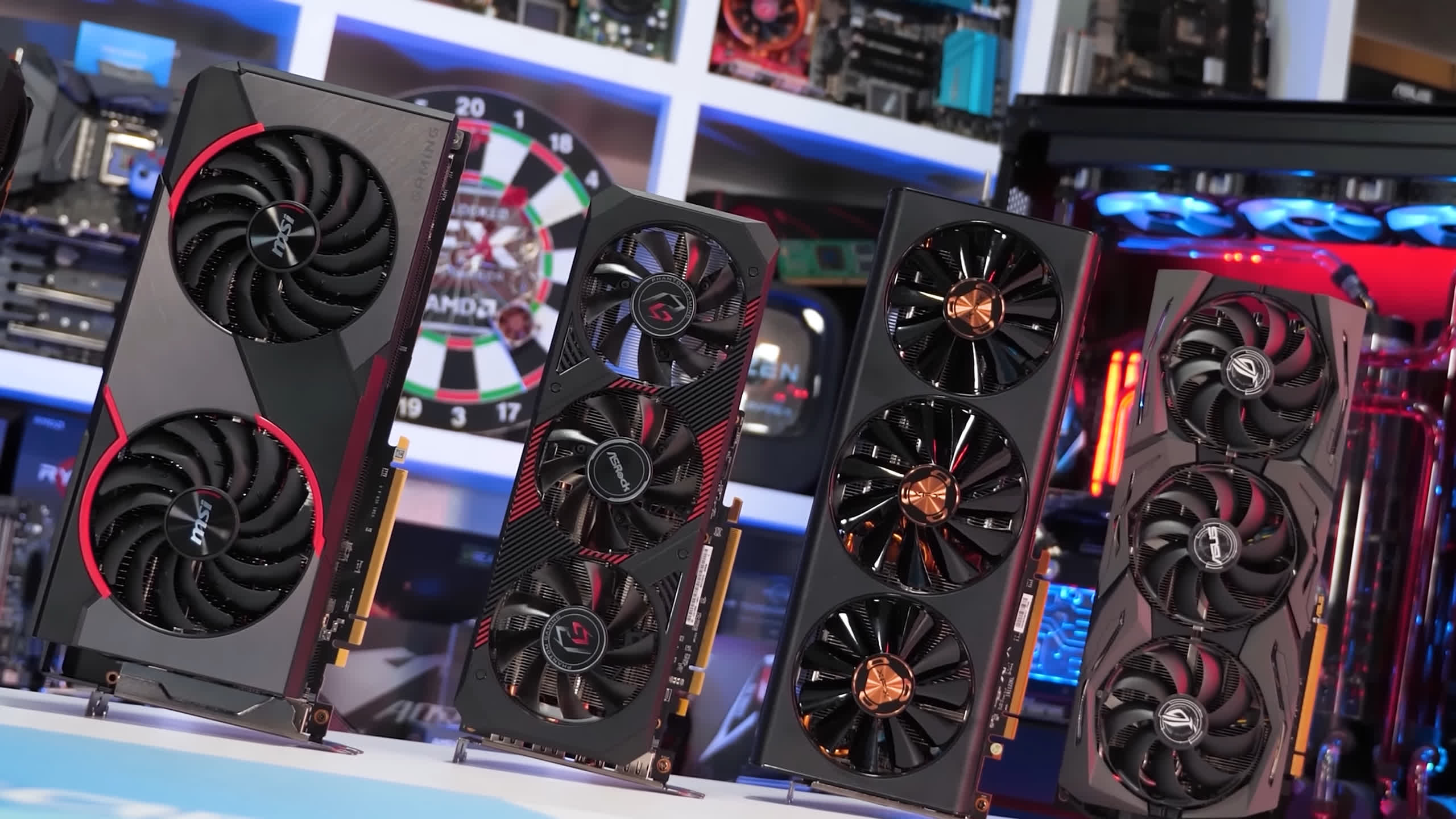
To see how we got here, we have to go back almost six years. In early 2020, AMD finally launched the Radeon RX 5600 XT, a mid-range card that showed up a full year after Nvidia’s GeForce RTX 2060. By then, Nvidia had already responded by cutting the price of the RTX 2060 from $350 to $300, while AMD entered at $280.
| Radeon 9060 XT 8GB | Radeon 7600 | Radeon 6600 | Radeon 5600 XT | |
|---|---|---|---|---|
| Price MSRP | $299 | $329 | $329 | $279 |
| Release Date | Jun 2025 | Jan 2024 | Oct 2021 | Jan 2020 |
| Process | TSMC N4P | TSMC N6 | TSMC 7nm | TSMC 7nm |
| Die Size (mm2) | 199 mm² | 204 mm² | 237 mm² | 251 mm² |
| Core Config | 2048:128:64 | 2048:128:64 | 1792:112:64 | 2304:144:64 |
| L2 Cache (MB) | 4 MB | 2 MB | 2 MB | 3 MB |
| GPU Boost Clock | 3130 MHz | 2655 MHz | 2491 MHz | 1560 MHz |
| Memory Capacity | 8GB | 8GB | 8GB | 6GB |
| Memory Speed | 20 Gbps | 18 Gbps | 14 Gbps | 14 Gbps |
| Memory Type | GDDR6 | GDDR6 | GDDR6 | GDDR6 |
| Bus Type / Bandwidth |
128-bit, 320 GB/s |
128-bit, 288 GB/s |
128-bit, 224 GB/s |
192-bit, 288 GB/s |
| PCIe Bus Interface | PCIe 5.0 x16 | PCIe 4.0 x8 | PCIe 4.0 x8 | PCIe 4.0 x16 |
| Total Board Power | 150 W | 165 W | 132 W | 150 W |
The 5600 XT wasn’t a bad card, but it didn’t impress the way the higher-end 5700 XT had. Performance was on par with the RTX 2060, but AMD users missed out on Nvidia’s rapidly improving DLSS upscaling tech and early ray tracing support – though, to be fair, ray tracing on the 2060 was pretty useless due to its limited VRAM and overall insufficient GPU power. In the end, Nvidia’s offering felt more polished, even if AMD’s effort was respectable, hiccups and all.
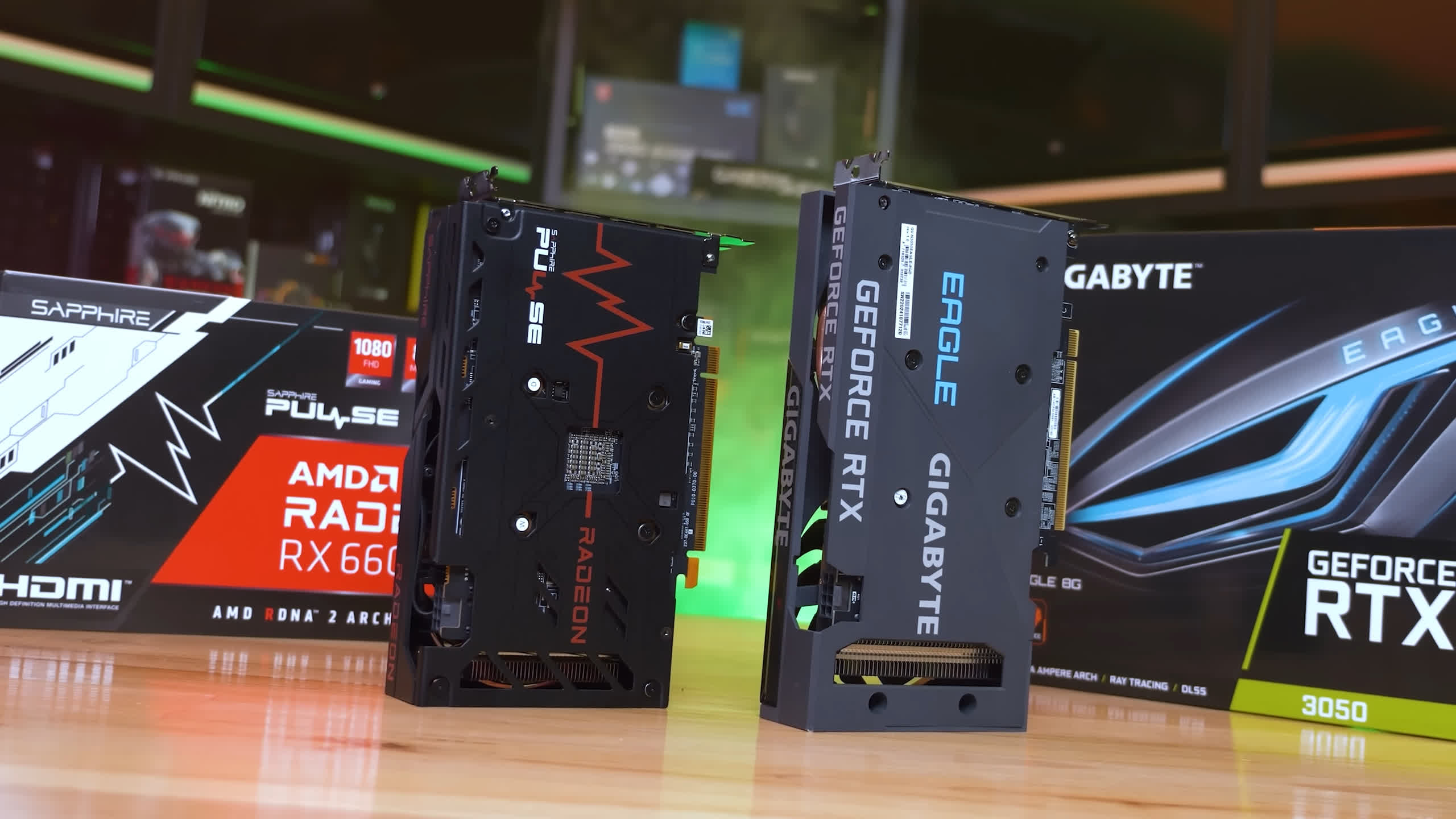
The next generation unfolded during the height of the cryptocurrency mining boom, a chaotic time when both companies were selling every GPU they could make. AMD, focused on moving units, didn’t even try to compete on price and was, once again, late to market. The Radeon RX 6600 arrived roughly eight months after Nvidia’s GeForce RTX 3060.
On paper, both had the same $330 MSRP, but in reality, neither card sold anywhere near that figure. This generation was somewhat of a wash… demand from miners sent prices skyrocketing, with the modest 8GB RX 6600 going for as much as $600 at the peak in 2021. When the crypto bubble burst in mid-2022, prices came crashing down, eventually dropping below MSRP.
| GeForce RTX 5060 |
GeForce RTX 4060 |
GeForce RTX 3060 12GB |
GeForce RTX 2060 |
|
|---|---|---|---|---|
| Price MSRP | $300 | $300 | $329 | $349 |
| Release Date | May 2025 | Jun 2023 | Feb 2021 | Jan 2019 |
| Process | TSMC 4N | TSMC 4N | Samsung 8nm | TSMC 12nm |
| Die Size (mm2) | 181 mm² | 158.7 mm² | 276 mm² | 445 mm² |
| Core Config | 3840:120:48 | 3072:96:48 | 3584:112:28 | 1920:240:30 |
| L2 Cache (MB) | 32 MB | 24 MB | 3 MB | 3 MB |
| GPU Boost Clock | 2497 MHz | 2460 MHz | 1777 MHz | 1680 MHz |
| Memory Capacity | 8GB | 8GB | 12GB | 6GB |
| Memory Speed | 28 Gbps | 17 Gbps | 15 Gbps | 14 Gbps |
| Memory Type | GDDR7 | GDDR6 | GDDR6 | GDDR6 |
| Bus Type / Bandwidth |
128-bit, 448 GB/s |
128-bit, 272 GB/s |
192-bit, 360 GB/s |
192-bit, 336 GB/s |
| PCIe Bus Interface | PCIe 5.0 x8 | PCIe 4.0 x8 | PCIe 4.0 x16 | PCIe 3.0 x16 |
| Total Board Power | 145 W | 115 W | 170 W | 160 W |
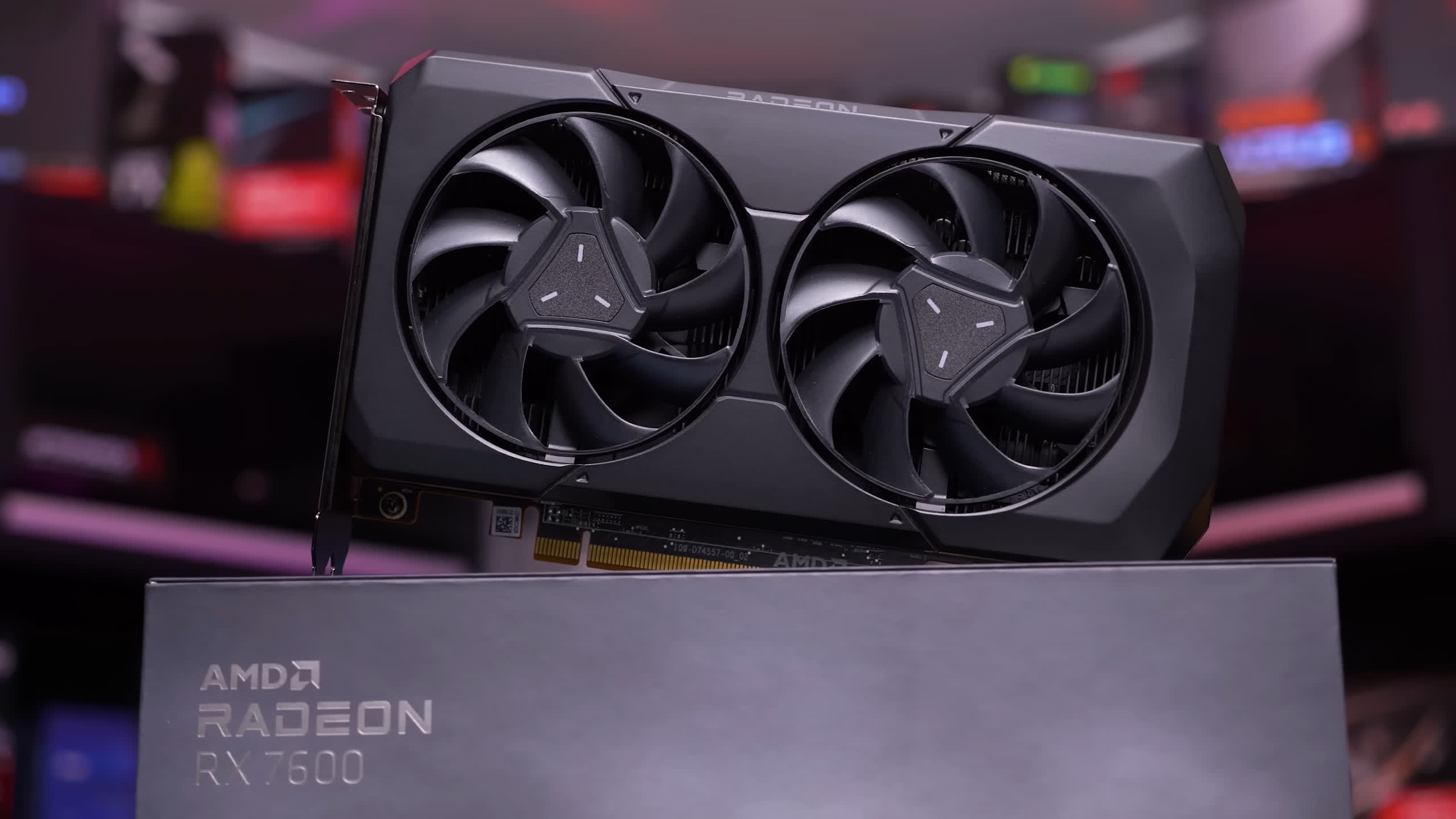
Having misjudged demand, Nvidia and especially AMD was left with warehouses full of unsold stock. Even as it launched its next generation, the RDNA3-based Radeon 7000 series, AMD was still working to clear out leftover RDNA2 GPUs well into the following year.
This set the stage for one of the most disappointing product cycles in recent memory. With the mining boom largely over and AI demand still in its early stages, things hadn’t gotten too crazy yet. Even so, both companies – especially Nvidia – had developed a taste for fatter margins and were not ready to go back to the old ways just yet.
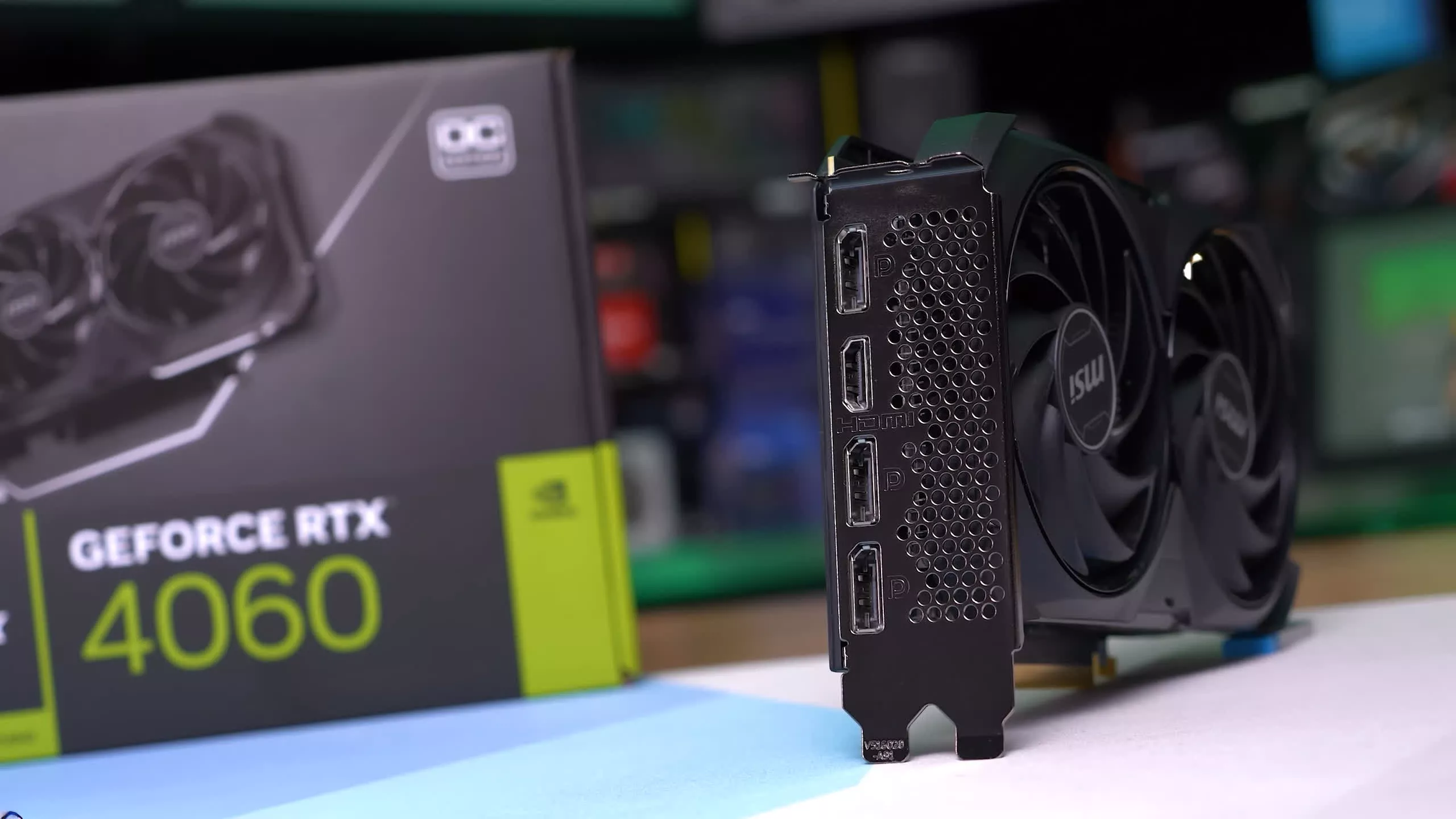
For budget gamers, this resulted in poor value and minimal performance upgrades. The RTX 4060 arrived at $300 with just 8GB of VRAM, while AMD’s competing Radeon RX 7600 offered no meaningful improvements and, in some cases, actually performed worse.
And that brings us to today. With AI driving chip demand higher than ever, $300 still buys you an 8GB GPU. Compared to the disappointing previous generation, today’s cards may feel like progress – but for anyone hoping for a true return to budget-friendly performance, the wait continues.
Test System Specs
Now, let’s compare how these various Radeon and GeForce GPUs stack up. We are especially interested in looking back at the competition over the past five years. As usual for this testing, we are using the Ryzen 7 9800X3D to reduce CPU bottlenecks, paired with DDR5-6000 CL30 memory.
| CPU | AMD Ryzen 7 9800X3D |
| Motherboard | MSI MPG X870E Carbon WiFi (BIOS 7E49v1A23 – ReBAR enabled) |
| Memory | G.Skill Trident Z5 RGB DDR5-6000 [CL30-38-38-96] |
| Graphics Cards |
Radeon RX 5600 XT 6GB |
| ATX Case | MSI MEG Maestro 700L PZ |
| Power Supply | Kolink Regulator Gold ATX 3.0 1200W |
| Storage | TeamGroup T-Force Cardea Z44Q 4TB |
| Operating System | Windows 11 24H2 |
| Display Driver | Nvidia GeForce Game Ready 581.29 AMD Radeon Adrenalin 25.9.2 |
Let’s get started.
Benchmarks
Call of Duty: Black Ops 6
First up, we have Call of Duty: Black Ops 6, and we’ll start with the “Basic” preset, which was tested at 1080p and 1440p. Looking back at the 5600 XT and RTX 2060, we see that performance was very similar in this game. That probably doesn’t bode well for the Radeon GPU, as this title usually favors AMD graphics cards.
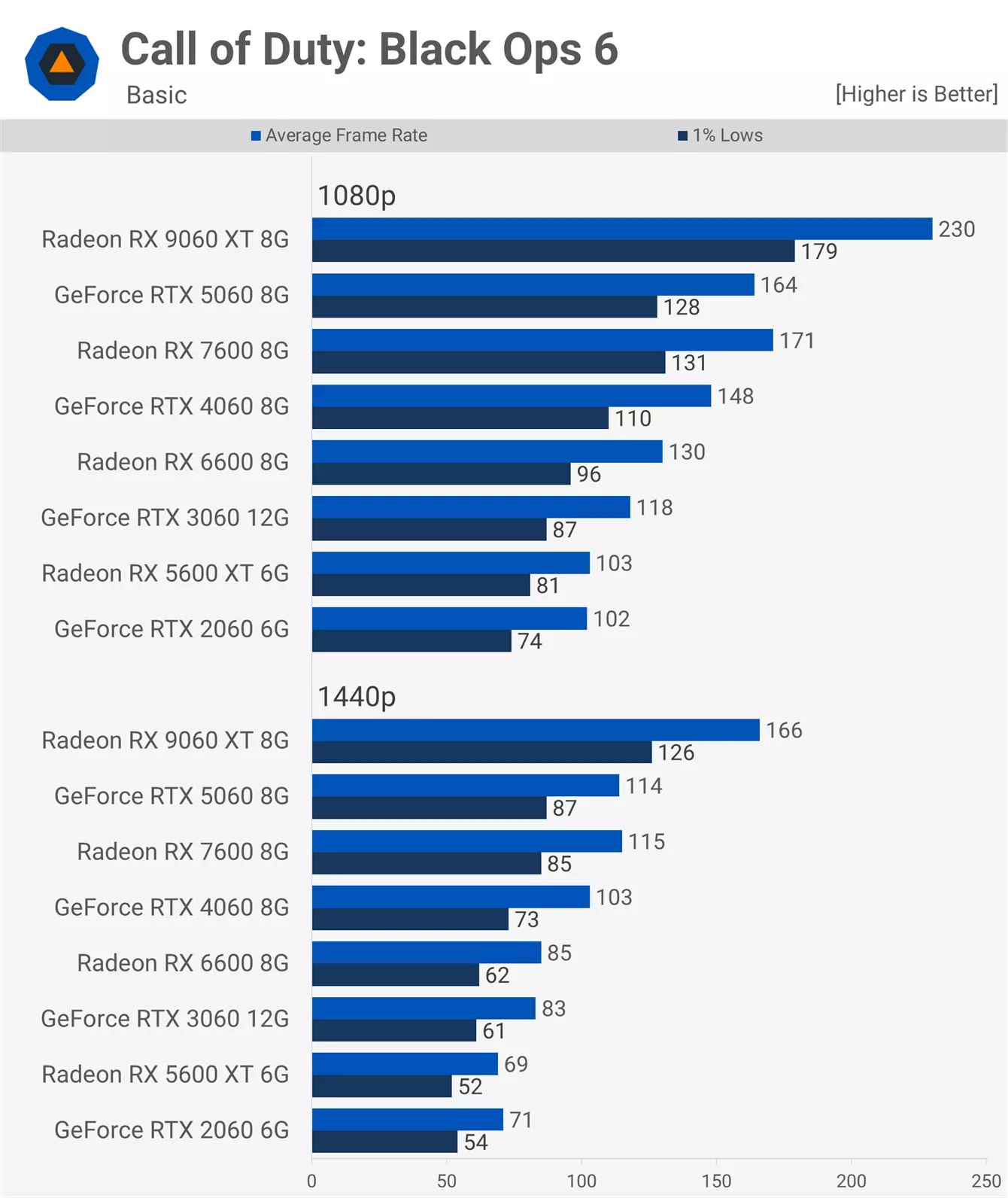
In the next generation, with the RX 6600 and RTX 3060, performance was again very close, especially at 1440p. At 1080p, the RX 6600 was 10% faster, which is a reasonable performance gain.
The margin grows with the RTX 4060 and RX 7600 matchup. Here, the Radeon GPU was 16% faster at 1080p and 12% faster at 1440p. This game typically leans toward Radeon GPUs, but even so, that’s a solid win for the RX 7600.
Now, looking at the latest cards, we have the 9060 XT 8GB and RTX 5060, and the RTX 5060 really struggles here. The Radeon GPU was 40% faster at 1080p and an even larger 46% faster at 1440p. The RTX 5060 could only roughly match the RX 7600, so not a great showing for Nvidia.
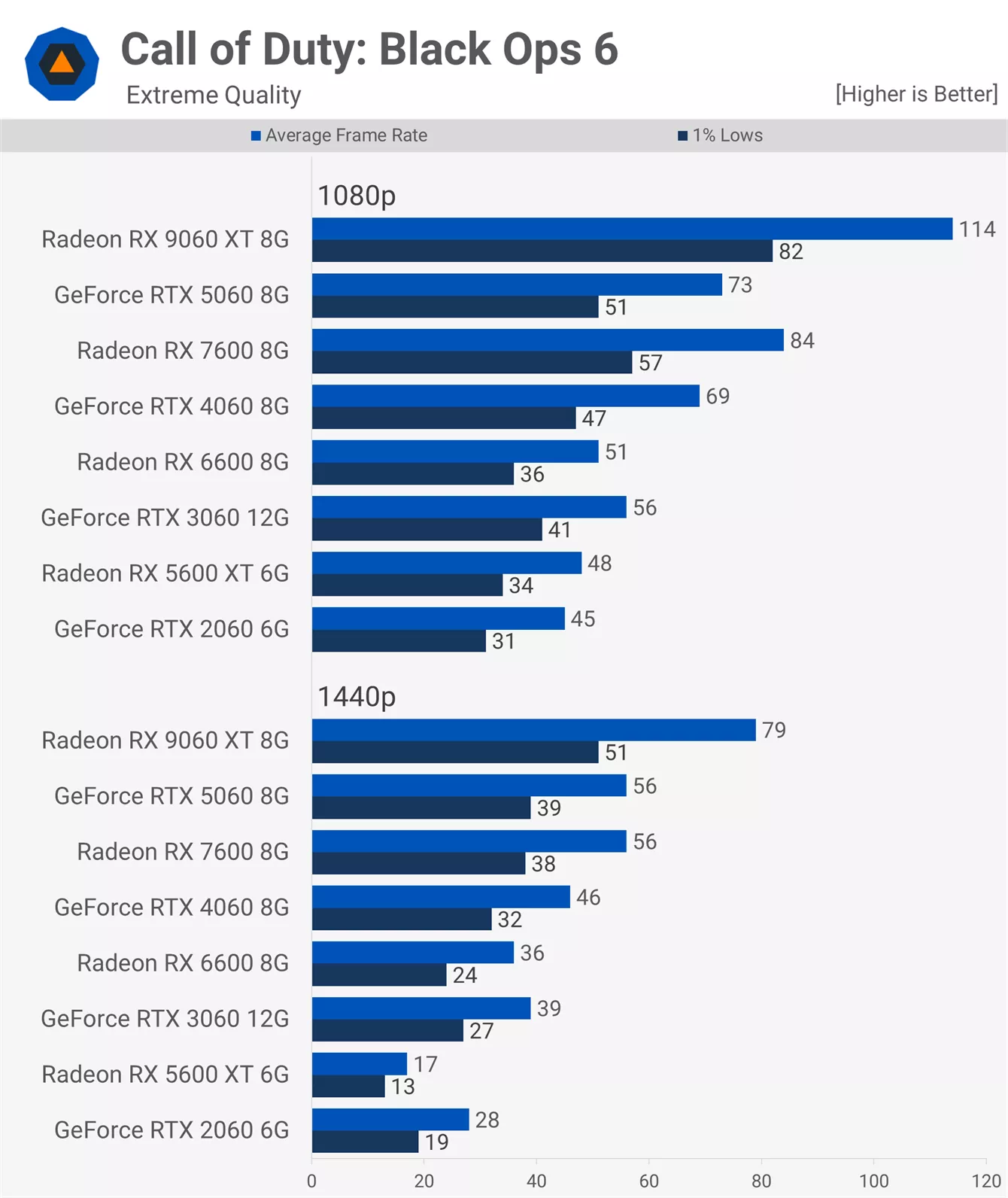
Switching to the “Extreme” preset changes things quite a bit. Most of these GPUs can’t maintain over 60 fps at 1440p. In fact, the 9060 XT was the only model to achieve that, beating the RTX 5060 by a 41% margin.
At 1080p, the 9060 XT was an incredible 56% faster than the RTX 5060. Interestingly, the new budget Blackwell GPU was only 6% faster than the RTX 4060, making it noticeably slower than the RX 7600.
Cyberpunk 2077: Phantom Liberty
Next up, we have Cyberpunk 2077. Starting with the “Low” quality preset, at 1080p the RTX 2060 beat the 5600 XT by 8%, and by 14% at 1440p, giving Nvidia a clear win. Nvidia also took the lead in the next generation, with the RTX 3060 easily beating the RX 6600 by 10% at 1080p and 13% at 1440p.
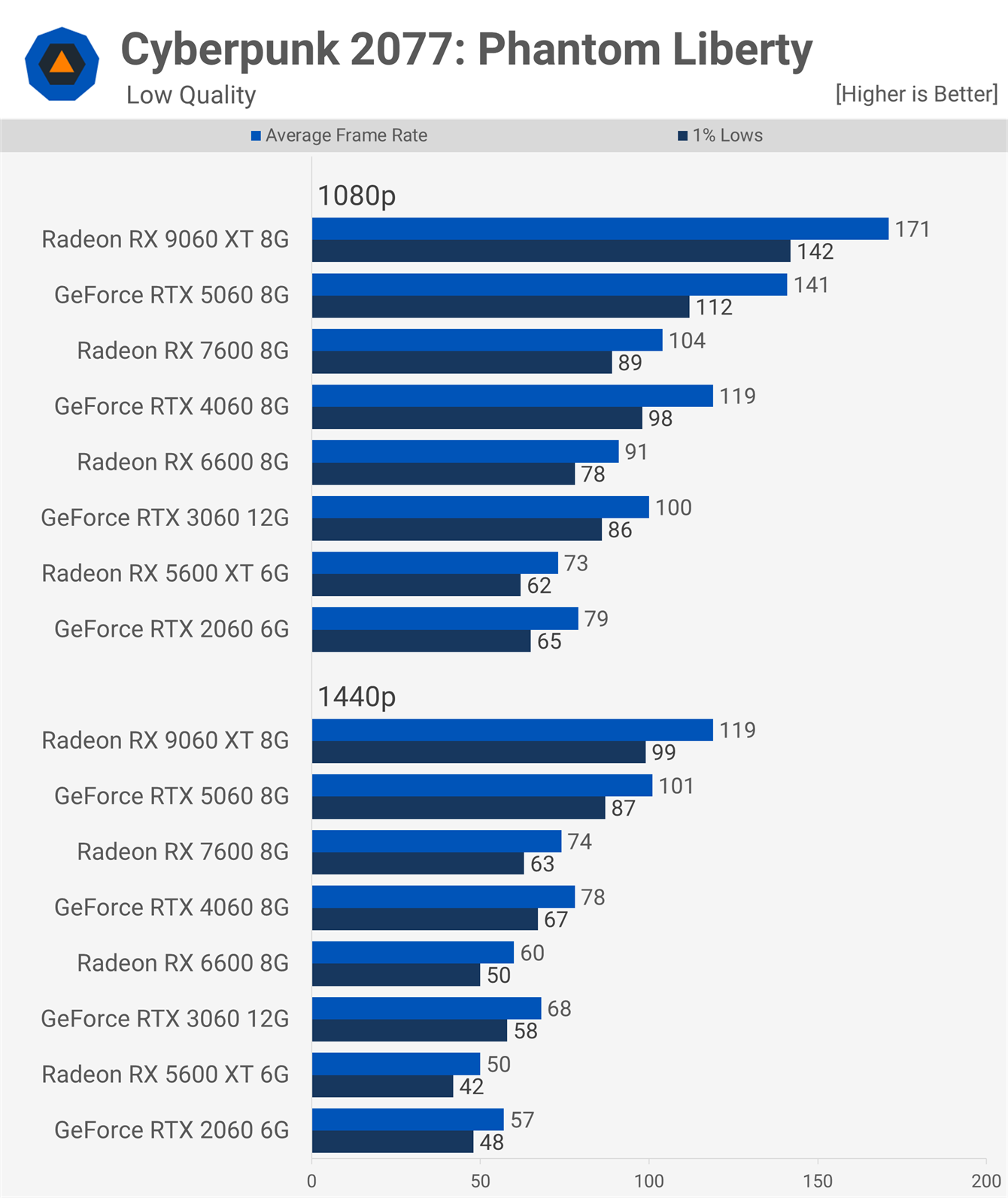
Then we have the RTX 4060 vs. RX 7600 matchup. Here, the GeForce GPU was 14% faster at 1080p and 5% faster at 1440p.
Where AMD pulls ahead is in this current generation. The 9060 XT 8GB delivered 21% greater performance at 1080p and 18% greater performance at 1440p compared to the RTX 5060. The 1% lows of the 9060 XT roughly matched the average frame rate of the RTX 5060, making this a decisive win for the Radeon GPU.
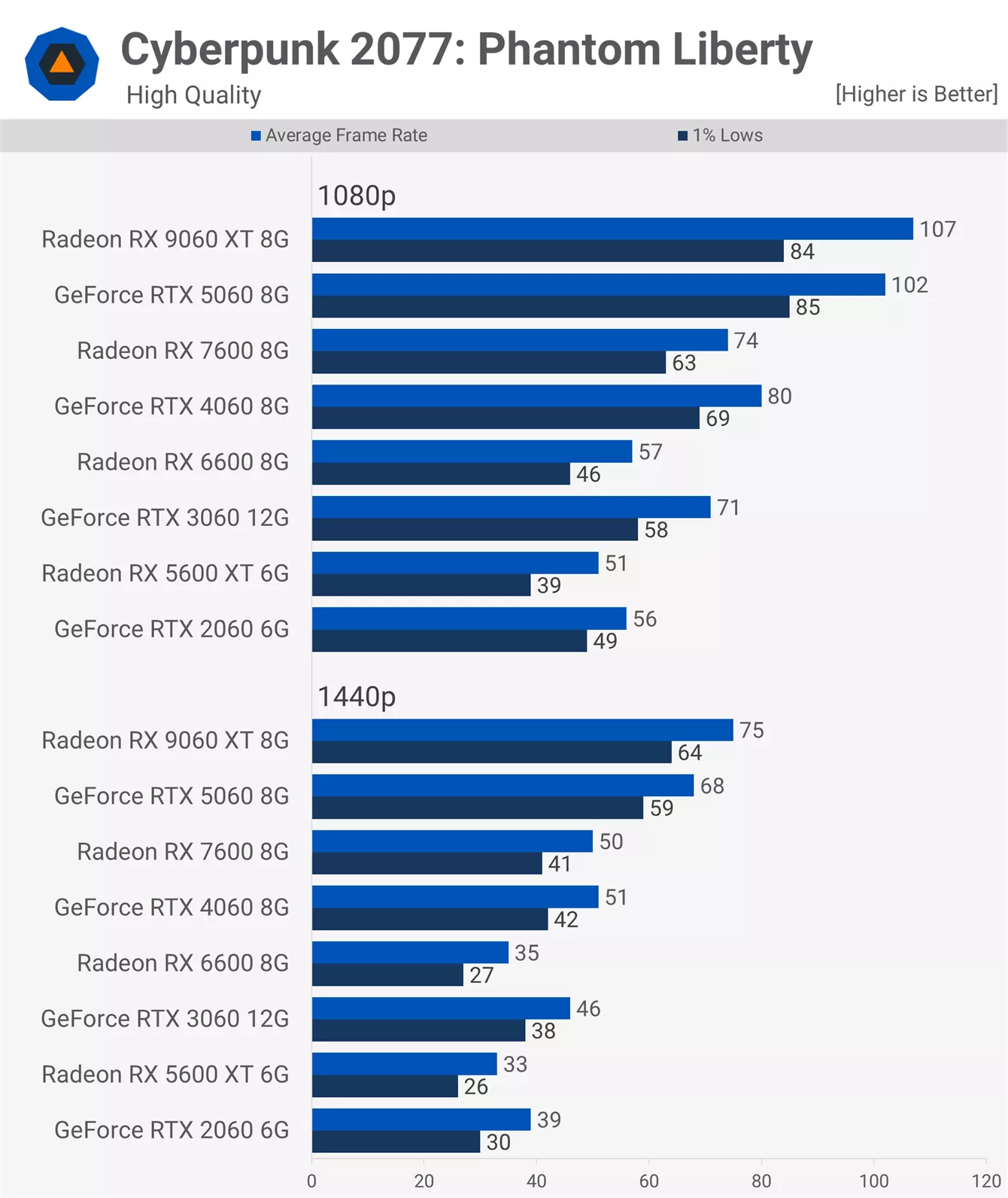
Switching to the “High” preset shifts the results slightly. The RTX 2060 still beat the 5600 XT, delivering 10% greater performance at 1080p and 18% at 1440p, though both GPUs fell well below 60 fps.
The RTX 3060 created a massive gap over the RX 6600, showing a 25% performance increase at 1080p and 31% at 1440p, leaving no contest in that matchup.
The RTX 4060 and RX 7600 were much closer, with nearly identical performance at 1440p. However, at 1080p, the GeForce GPU was 8% faster.
With the latest generation, performance was much more balanced. The 9060 XT 8GB was only 5% faster at 1080p and 10% faster at 1440p, a reasonable win but not nearly as dominant as before.
Horizon Zero Dawn Remastered
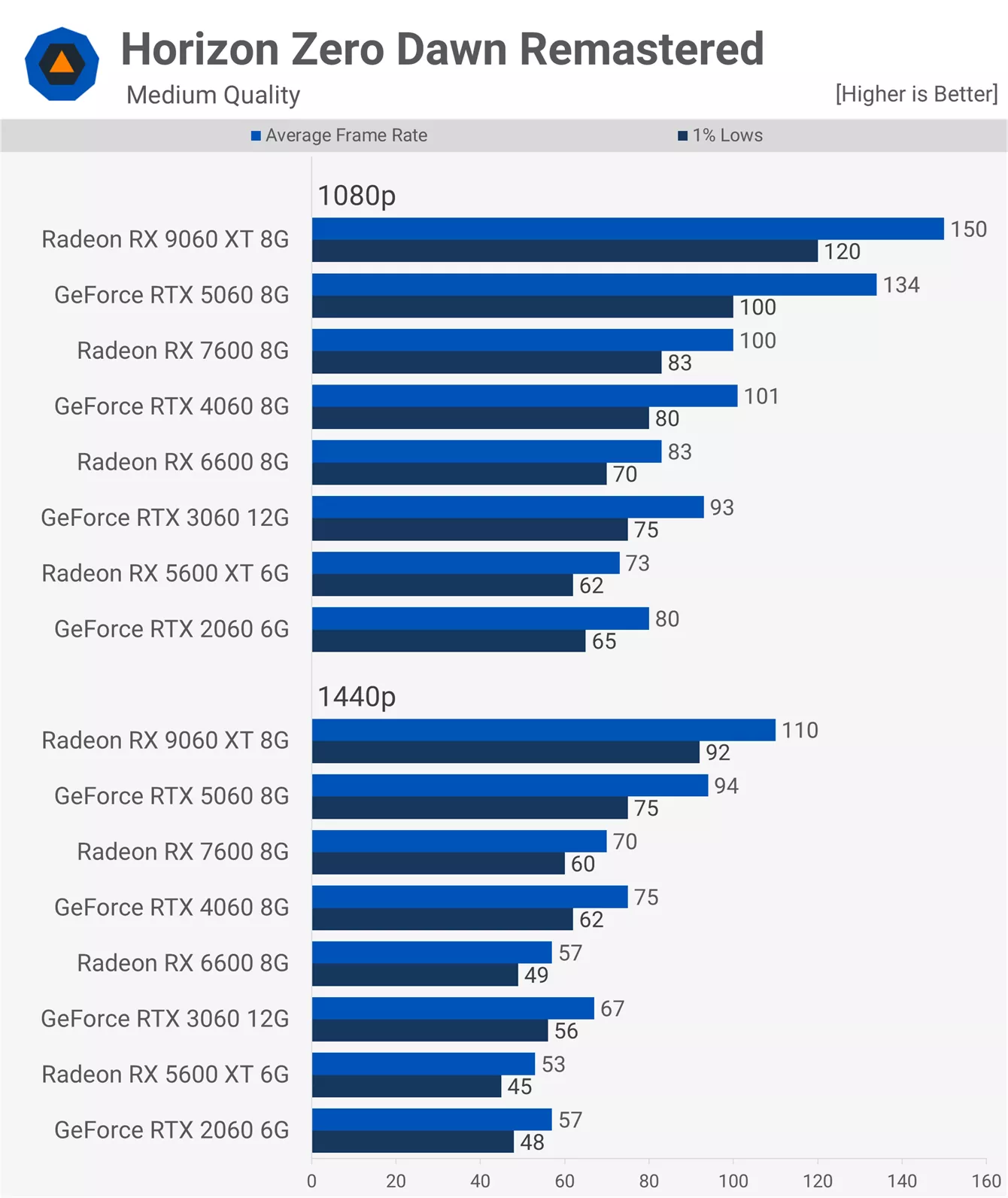
Now, let’s move on to Horizon Zero Dawn Remastered, starting with the “Medium” quality preset. The RTX 2060 still held a clear advantage over the 5600 XT, delivering 10% greater performance at 1080p and 8% at 1440p.
The RX 6600 was also outmatched, with the RTX 3060 proving 12% faster at 1080p and a huge 18% faster at 1440p.
The RTX 4060 vs. RX 7600 battle was far more even, with nearly identical performance at 1080p and just a 7% lead for the GeForce GPU at 1440p, with similar 1% lows.
With the high-quality settings, the RTX 5060 performed better, but even then, the 9060 XT 8GB was still 12% faster at 1080p and 17% faster at 1440p, giving AMD a convincing win.
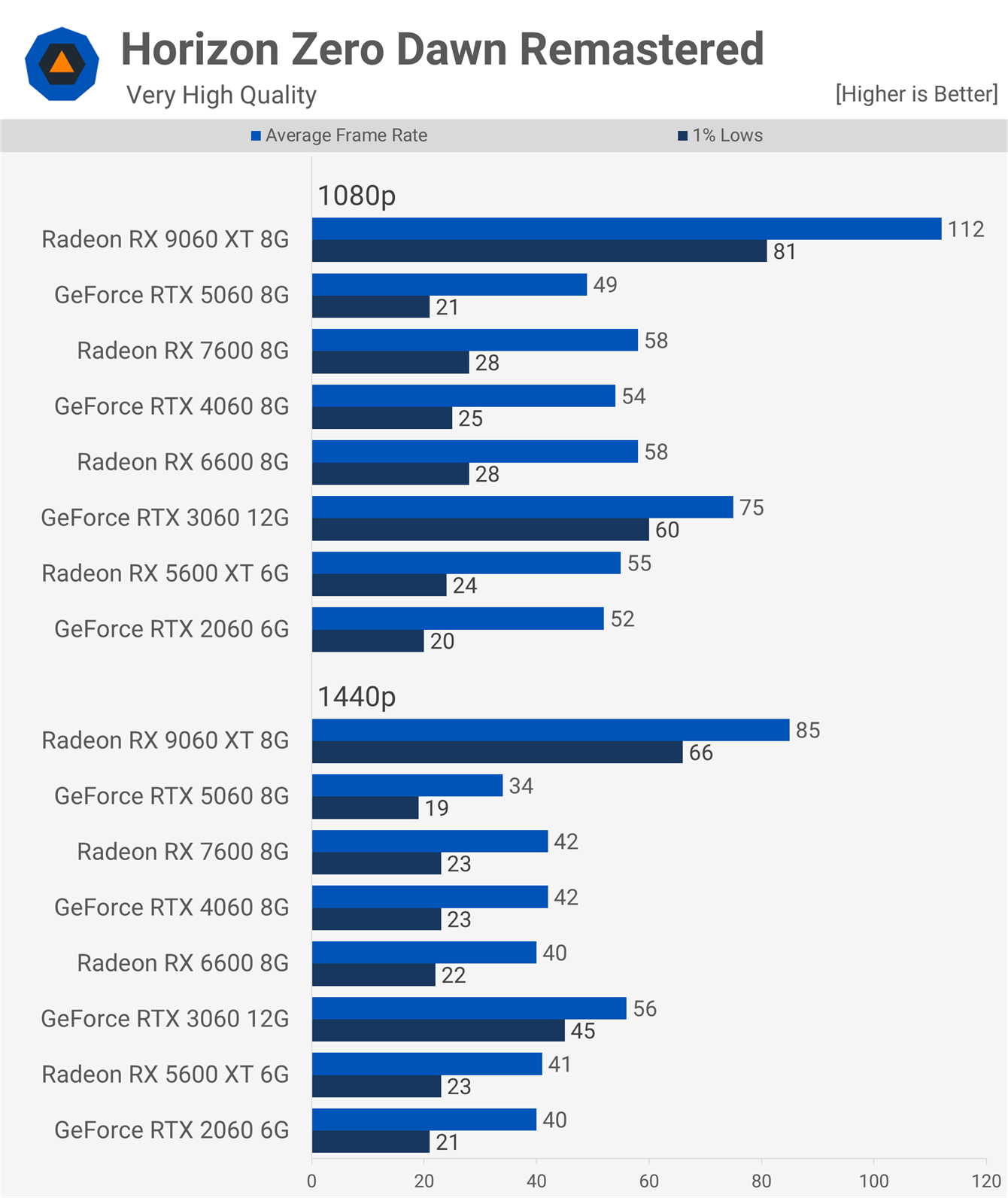
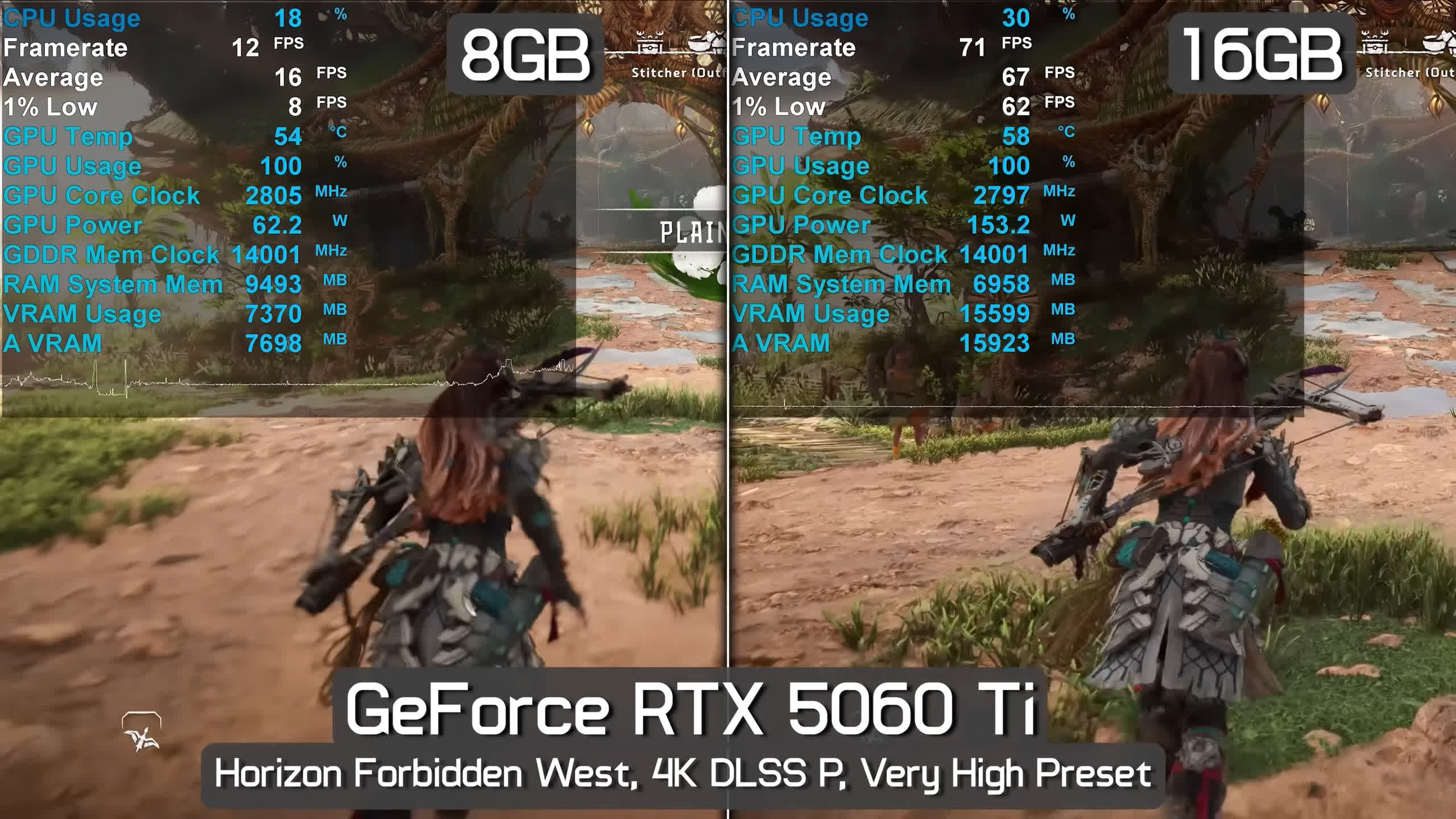
Switching to the “Very High” preset creates serious challenges for these GPUs. Under these settings, even at 1080p, the game demands more than 10GB of VRAM.
You might wonder how the 9060 XT 8GB avoids the severe performance issues seen with most other models. The exception here is the RTX 3060, which has 12GB of VRAM. The key difference comes down to the PCI Express interface. While the other budget GPUs have just 8 lanes, the 9060 XT uses a full 16 lanes, effectively doubling the bandwidth to system memory. This significantly helps performance when VRAM is exceeded.
It’s still not an ideal scenario, but as a result, the 9060 XT 8GB remains playable. In contrast, the RTX 5060, RX 7600, RTX 4060, RX 6600, 5600 XT, and RTX 2060 all suffer from severe stuttering and poor performance.
Kingdom Come: Deliverance II
Next up, we have Kingdom Come: Deliverance II, and we’ll start with the Medium quality data. In this title, the 5600 XT gets destroyed by the RTX 2060, as the GeForce GPU was 19% faster at 1080p and 13% faster at 1440p. As expected, the RX 6600 also falls behind the RTX 3060, with Nvidia delivering 10% greater performance at 1080p and a massive 20% at 1440p.
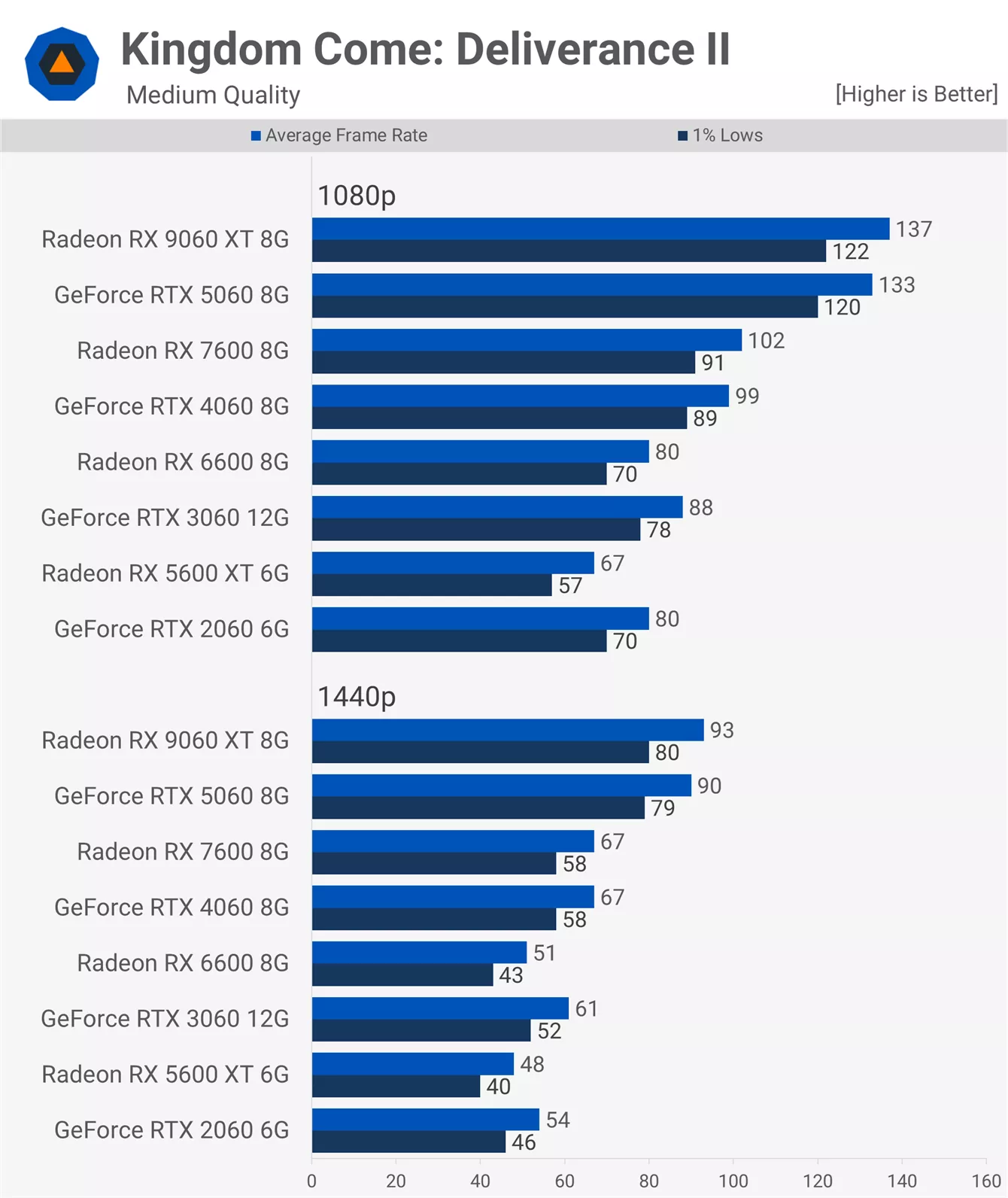
The RX 7600 and RTX 4060, on the other hand, were neck and neck at both resolutions, with just a few frames separating them at 1080p and virtually no difference at 1440p. Likewise, the RTX 5060 and 9060 XT 8GB were very evenly matched, with the Radeon GPU rendering just a few extra frames, making this one close enough to call a tie.
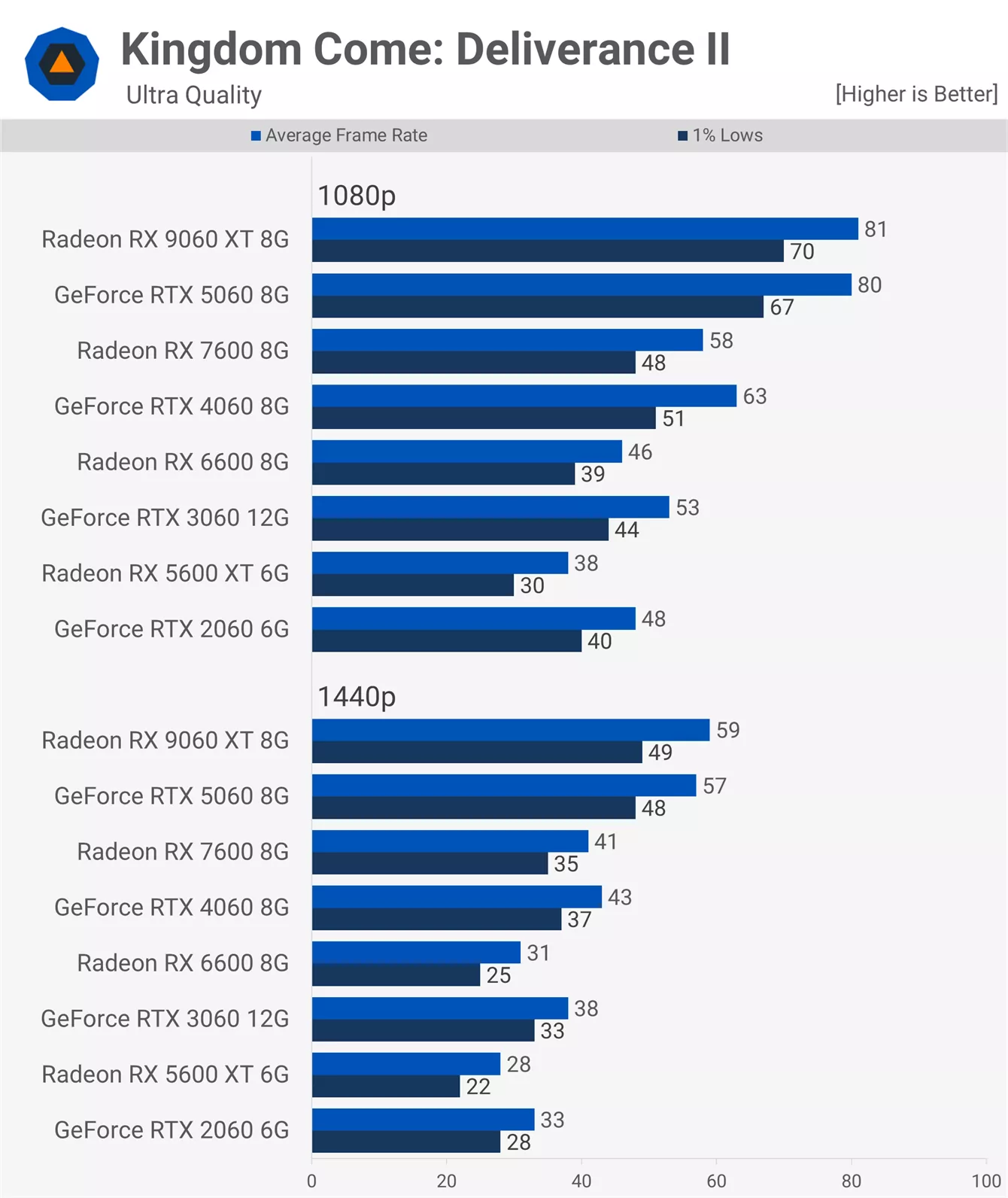
Switching to the Ultra preset, the results are mostly one-sided, with Nvidia clearly winning the majority of these matchups. The RTX 2060, for example, was 26% faster than the 5600 XT at 1080p and 18% faster at 1440p. Meanwhile, the RTX 3060 led the RX 6600 by 15% at 1080p and 23% at 1440p.
The RX 7600 was more competitive against the RTX 4060, but even so, the GeForce GPU was 9% faster at 1080p. Finally, with the newest GPUs, the 9060 XT 8GB and RTX 5060, the matchup was extremely close, with no more than 1 to 2 fps separating them.
Rainbow Six Siege X
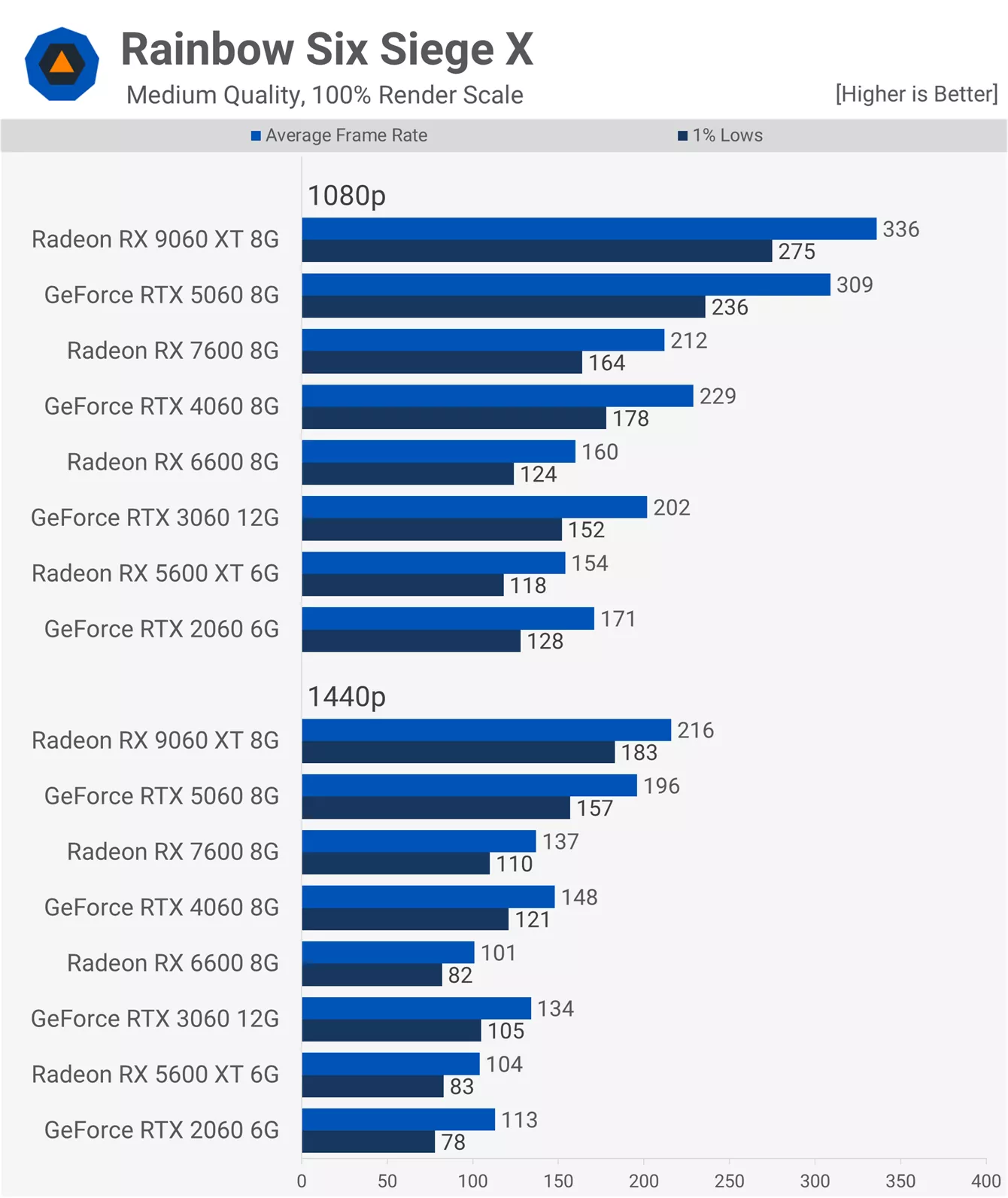
Rainbow Six Siege is another game where Nvidia has generally dominated over the years. Using the Medium preset with the render scale manually set to 100%, the RTX 2060 was 11% faster than the 5600 XT at 1080p and 9% faster at 1440p.
The RTX 3060 completely overpowered the RX 6600, delivering 26% greater performance at 1080p and an even larger 33% at 1440p. The RTX 4060 also defeated the RX 7600, producing 8% more frames at both 1080p and 1440p.
Despite Nvidia’s strong showing, the 9060 XT 8GB managed to outperform the RTX 5060, boosting performance by 9% at 1080p and 10% at 1440p. Those are solid gains for AMD here.
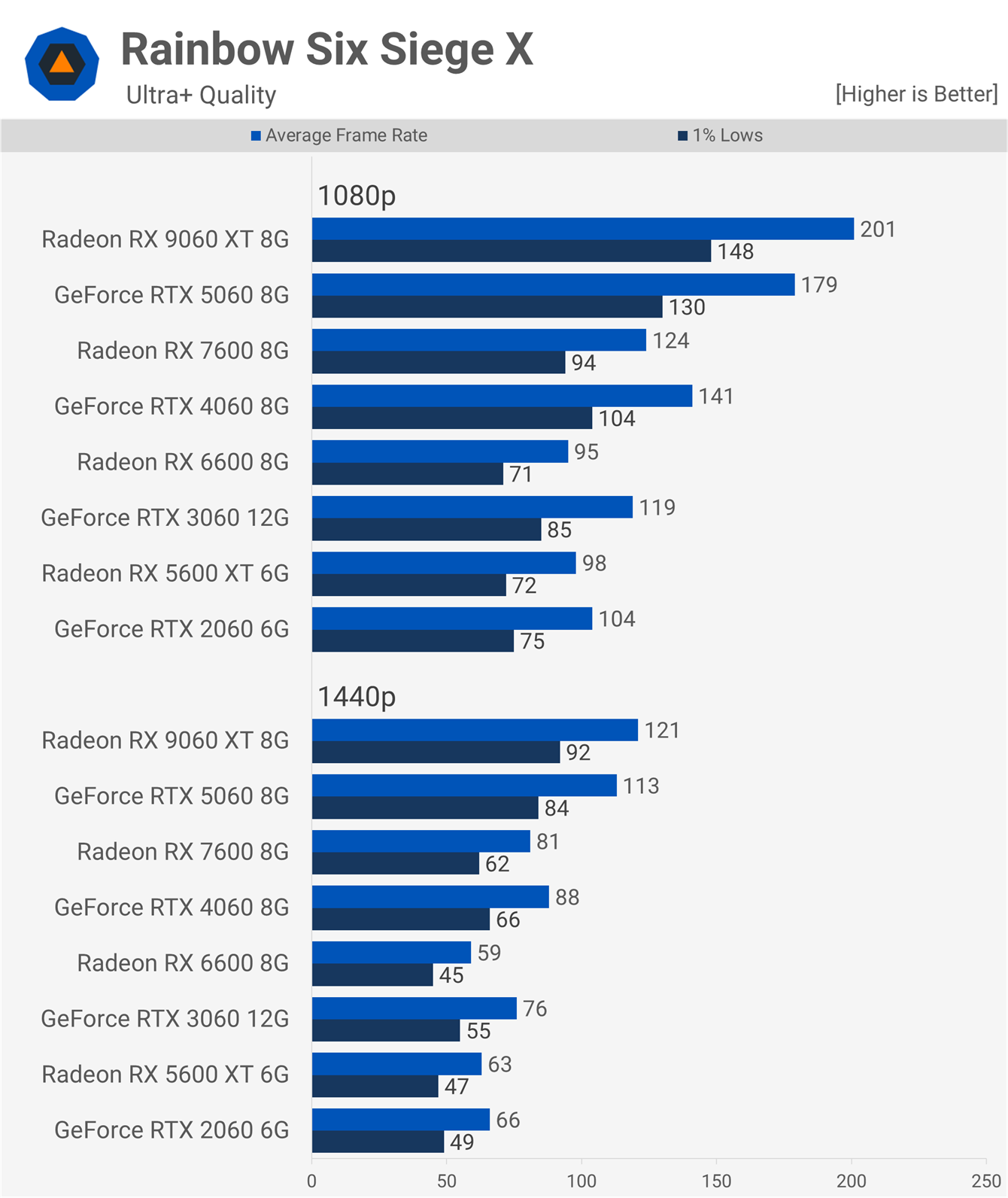
Switching to the Ultra preset, the RTX 2060 ended up just 6% faster than the 5600 XT at 1080p and 5% faster at 1440p.
For the next generation, AMD took a big hit, with the RTX 3060 delivering a dominant 25% lead at 1080p and 29% at 1440p. Surprisingly, the RX 6600 went from being only slightly faster than the 5600 XT at 1080p to actually slower at 1440p.
The RX 7600 also trailed the RTX 4060, as the GeForce GPU was 14% faster at 1080p and 9% faster at 1440p. That brings us to the latest match between the RTX 5060 and 9060 XT 8GB. Here, AMD claimed the win, with the Radeon GPU delivering 12% greater performance at 1080p and 7% at 1440p.
Warhammer 40,000: Space Marine 2
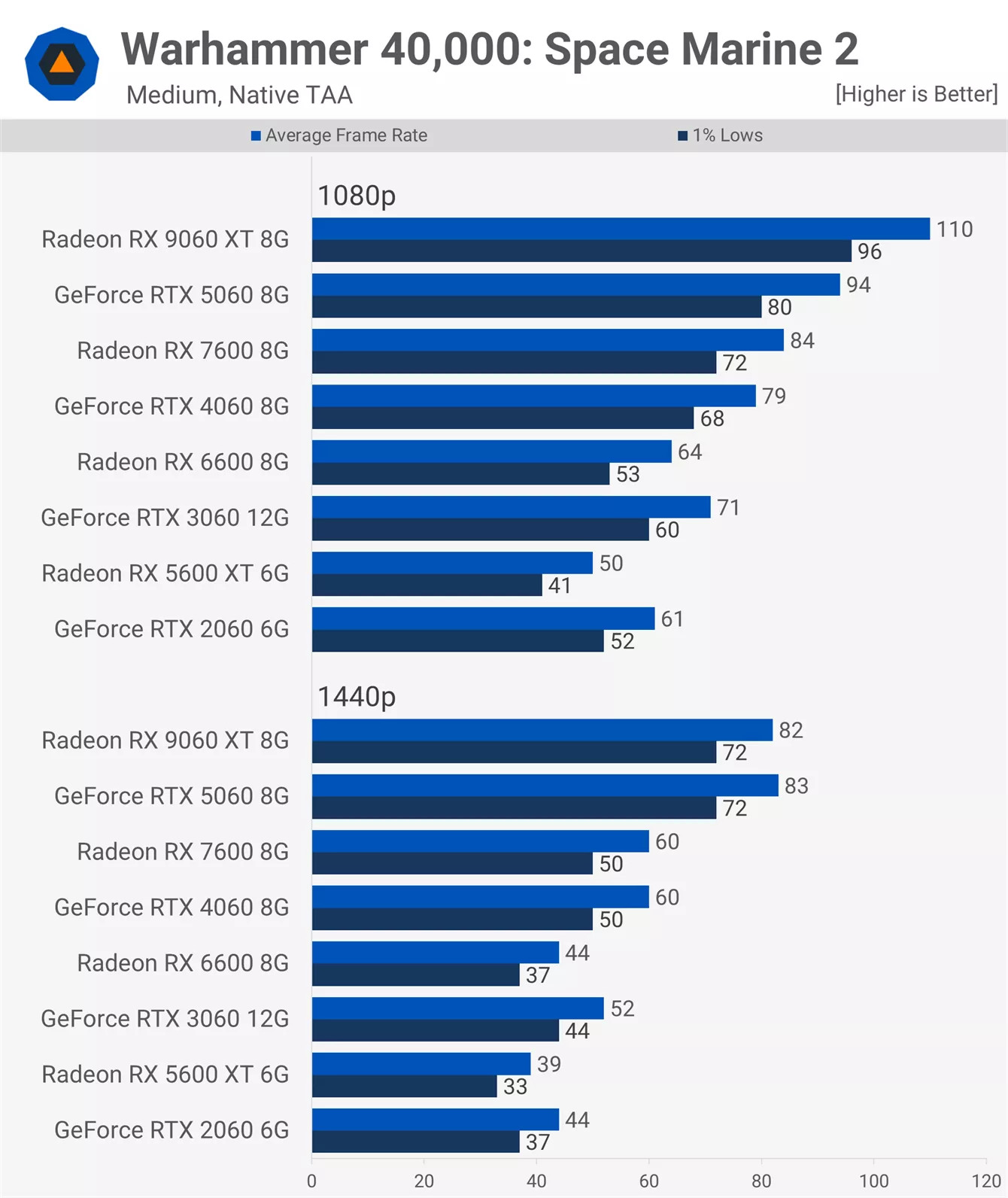
Now it’s time for Space Marine 2, and here we have some interesting results. The RTX 2060 crushed the 5600 XT, delivering 24% greater performance at 1080p and 13% at 1440p. The RTX 3060 also dominated the RX 6600, coming in 11% faster at 1080p and 18% faster at 1440p.
The RX 7600 and RTX 4060 were very evenly matched, as we often see. The RTX 4060 had a slight edge at 1080p, where it was 6% faster, but at 1440p, both GPUs averaged 60 fps.
Interestingly, with the latest generation, the results flipped. The 9060 XT 8GB crushed the RTX 5060 at 1080p, delivering 17% better performance, but at 1440p, they were neck and neck, each averaging just over 80 fps.
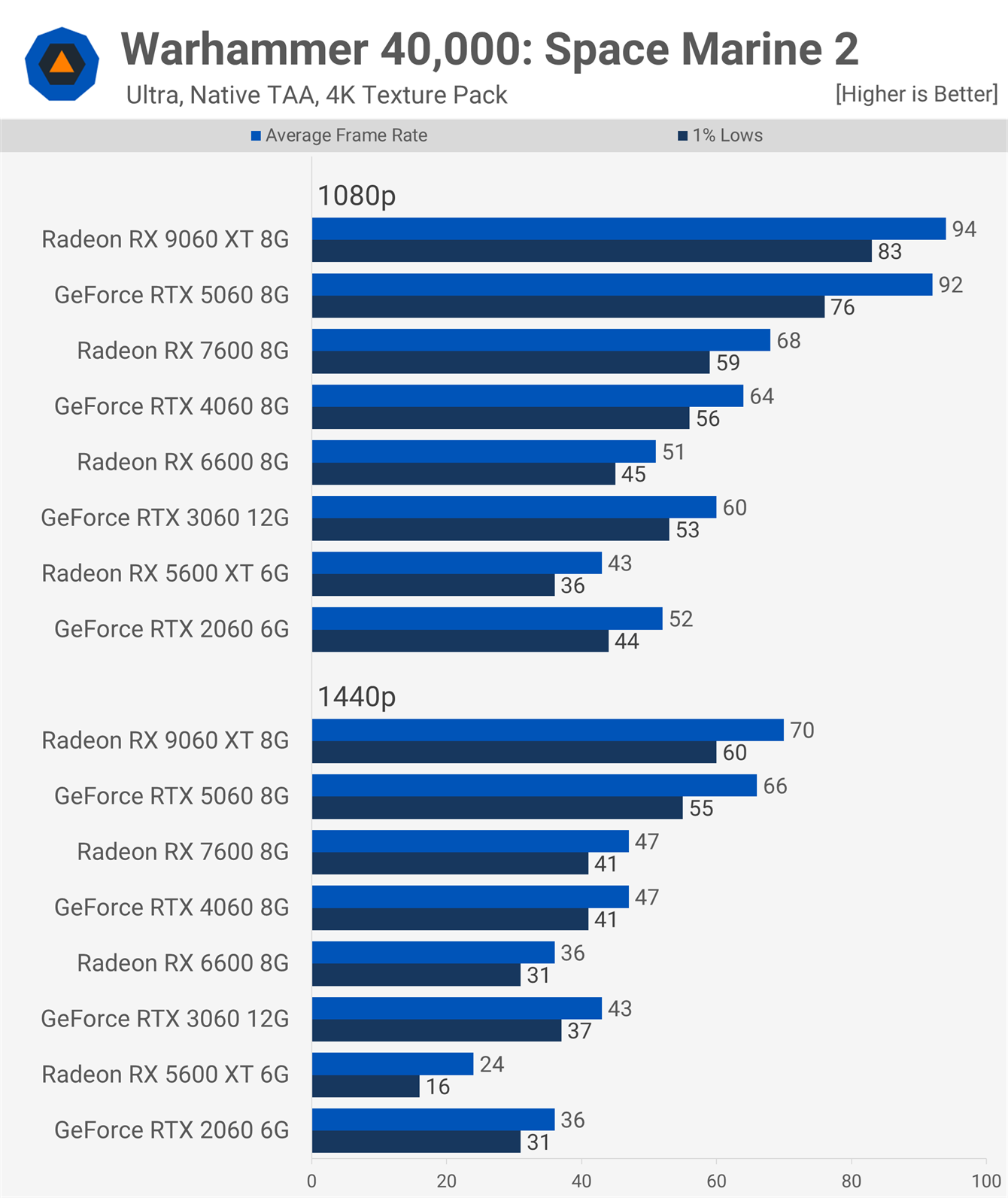
Using the Ultra preset, the 5600 XT could not handle the VRAM demands. Even though the RTX 2060 also has only 6GB of VRAM, it performed noticeably better. Still, neither GPU rendered the game correctly, so the fact that the 2060 was 21% faster at 1080p does not mean much in practical terms.
The RX 6600 was completely outclassed by the RTX 3060, which not only rendered the game correctly thanks to its 12GB of VRAM but was also 18% faster at 1080p.
The RX 7600 and RTX 4060 matchup was surprising. The Radeon GPU was 6% faster at 1080p, while both were evenly matched at 1440p. A similar trend was seen with the 9060 XT and RTX 5060, though the Radeon GPU produced slightly better overall performance with much stronger 1% lows.
Shadow of the Tomb Raider
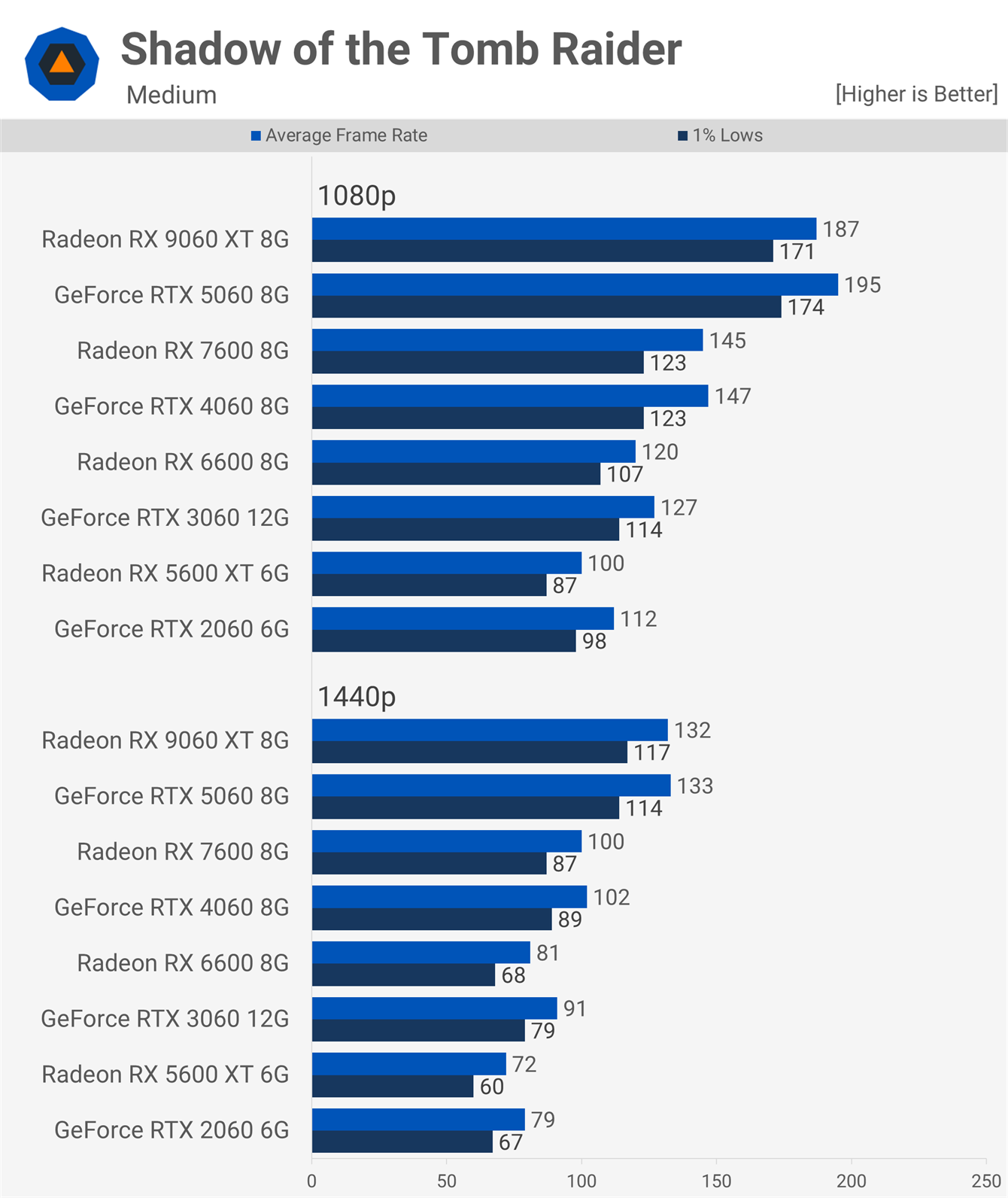
The last game we are going to look at is an old favorite, Shadow of the Tomb Raider. Starting with the Medium preset, all of these GPUs handle the game easily, making it a good test for comparing older models.
Here, the RTX 2060 was 12% faster than the 5600 XT at 1080p and 10% faster at 1440p.
Surprisingly, the RX 6600 and RTX 3060 were more closely matched, with the GeForce GPU 6% faster at 1080p and 12% faster at 1440p. The RX 7600 and RTX 4060 were neck and neck, and the same was true for the RTX 5060 and 9060 XT 8GB, though at 1080p, the GeForce GPU had a slight 4% lead.
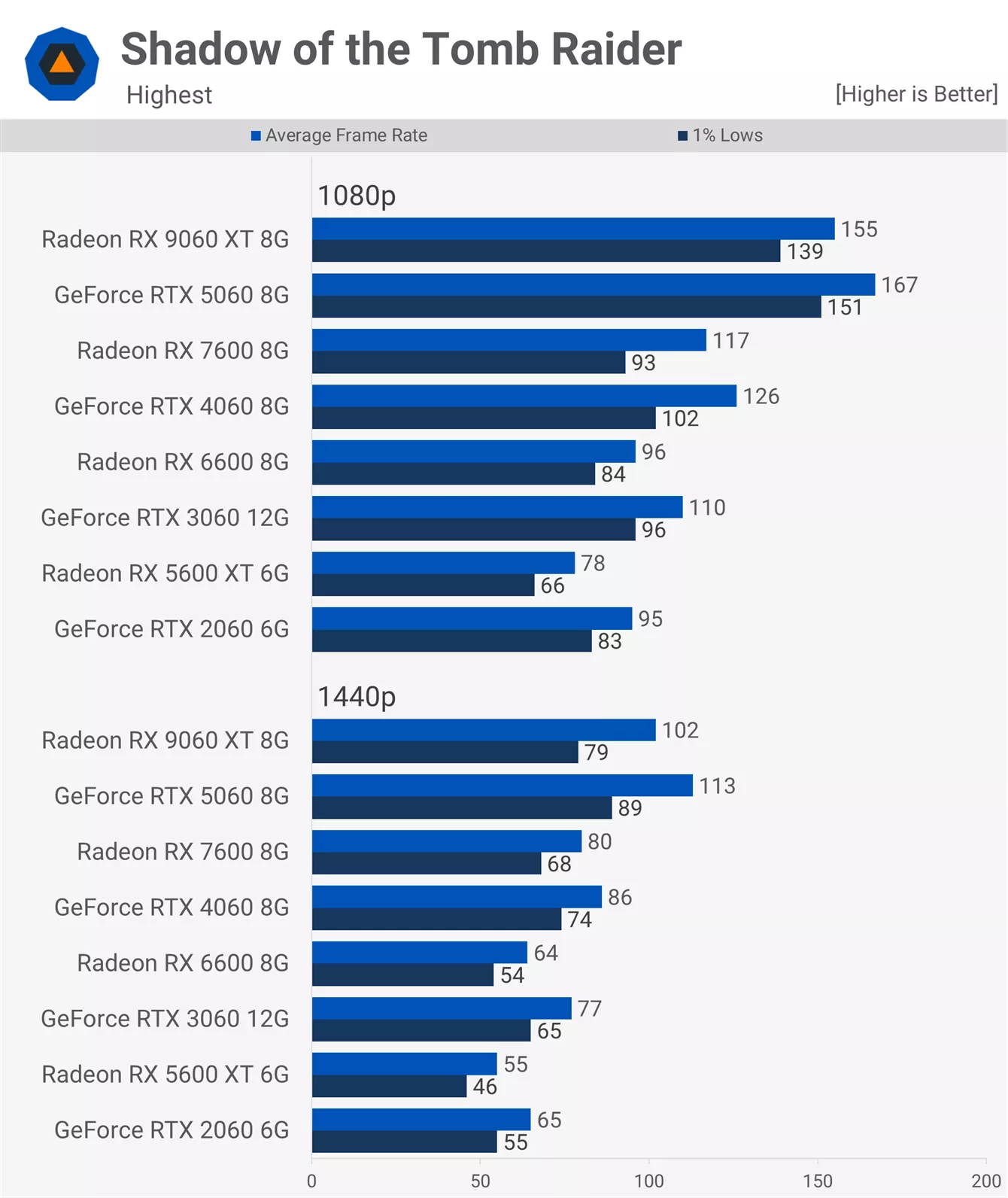
Switching to the highest preset pushed the older models down to or below 60 fps at 1440p. For example, the 5600 XT averaged just 55 fps, while the RTX 2060 was 22% faster at 1080p and 18% faster at 1440p.
The RTX 3060 outperformed the RX 6600 by 15% at 1080p and 20% at 1440p. Meanwhile, the RTX 4060 was 8% faster than the RX 7600 at both 1080p and 1440p.
Finally, we have the current generation matchup between the 9060 XT 8GB and RTX 5060. This time, the GeForce GPU came out ahead, delivering 8% greater performance at 1080p and 11% at 1440p.
Performance Summary
Let’s take a look at the 7-game average data, starting with the low to medium results. Across the games tested, the RTX 2060 ended up beating the 5600 XT by an 11% margin at 1080p and 10% at 1440p. It was comfortably ahead, meaning you’d need to be paying considerably less for the Radeon GPU to make it worth considering.
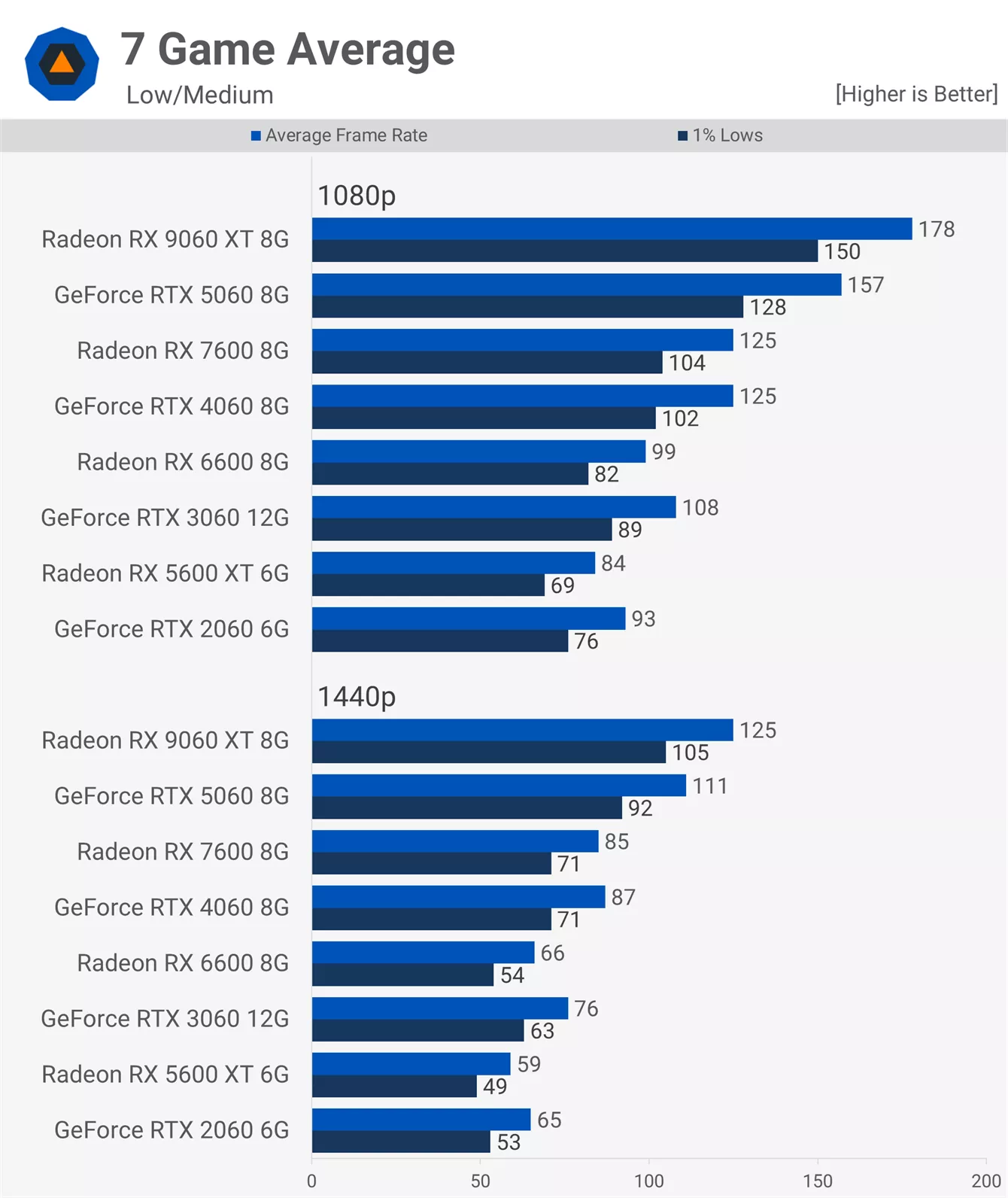
It’s a similar story with the RX 6600 vs. RTX 3060 matchup. The GeForce GPU was 9% faster at 1080p and 15% faster at 1440p. Of course, the RX 6600 eventually sold for significantly less, but at launch, both cards shared the same MSRP, and that was on AMD.
Next, we have the previous generation RX 7600 vs. RTX 4060. This matchup was a tie, with both GPUs delivering virtually identical performance overall, so there’s no clear winner here.
Now, looking at the current battle, AMD takes the lead. The 9060 XT 8GB was, on average, 13% faster than the RTX 5060 at both tested resolutions. This is the largest win we’ve seen at the $300 price point in several years.
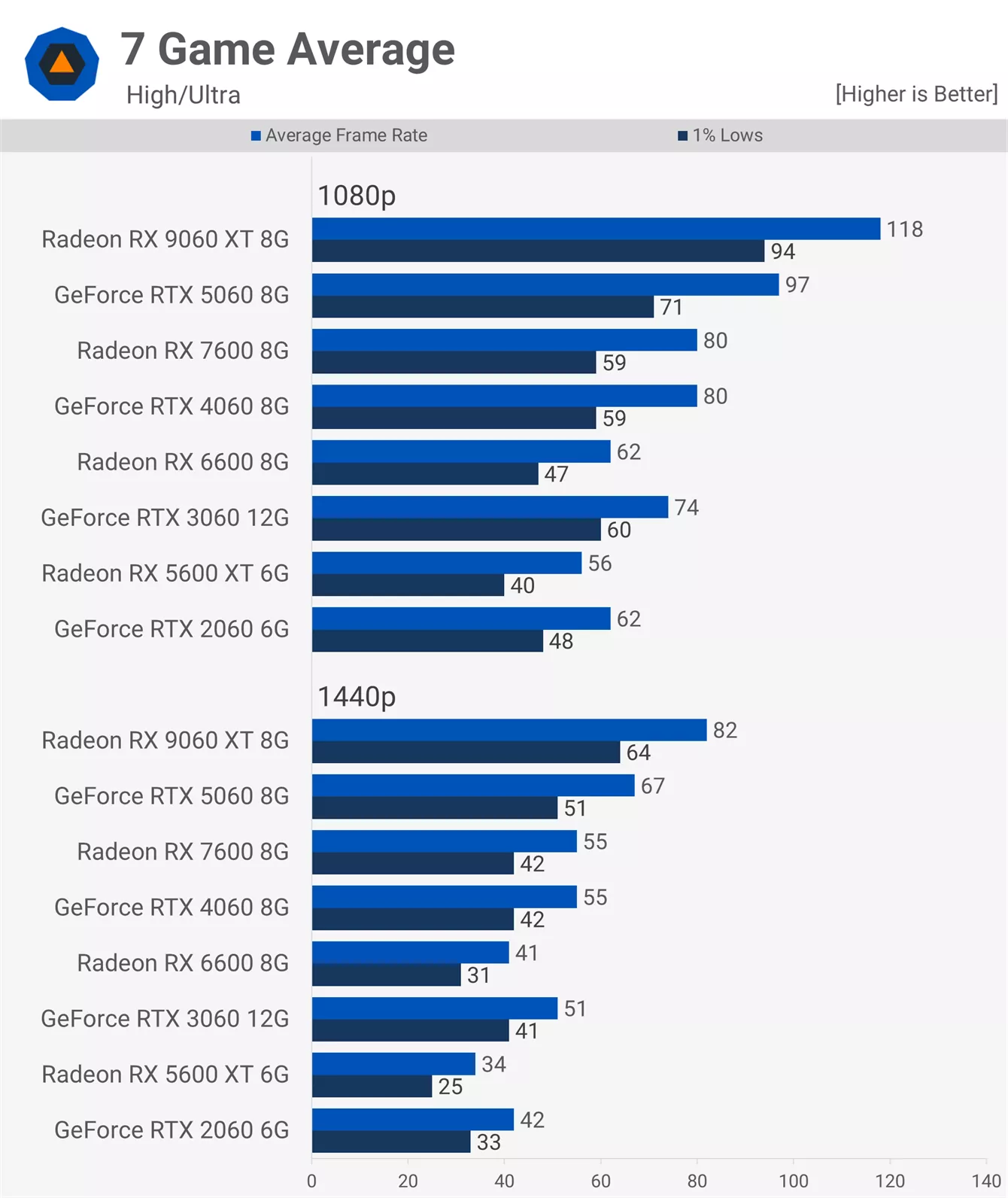
Now at Ultra quality, here the RTX 2060 was 11% faster than the 5600 XT at 1080p and 24% faster at 1440p. Then we have the RTX 3060 vs. RX 6600 matchup, where the Radeon GPU really struggled. The GeForce GPU was 19% faster at 1080p and 24% faster at 1440p.
The RX 7600 and RTX 4060, on the other hand, were neck and neck with virtually nothing separating them. As for the current generation, the 9060 XT 8GB finishes well ahead. It certainly benefits from the VRAM-limited Horizon Zero Dawn Remastered testing thanks to its additional PCIe lanes. In the end, the Radeon GPU was 22% faster at both resolutions, an easy win for AMD.
A Look Back – and Forward – at the Budget GPU Market
The budget gaming GPU market has been stuck for a long time, partly due to AMD’s unwillingness to compete aggressively. Take the Radeon RX 5600 XT. It was a perfectly serviceable GPU, but it showed up so late that Nvidia barely had to lift a finger. The company simply cut the price of its GeForce RTX 2060 by 14% and moved on. By then, neither card was particularly thrilling. Both shipped with just 6GB of VRAM, and a year-old discount wasn’t much to celebrate.
The next generation managed to be even worse, thanks to the chaos of the cryptocurrency boom. If AMD’s Radeon RX 6600 had been widely available at its launch price, it would have been laughable for the performance on offer. Instead, it was swept up in demand from miners, selling for far above MSRP – at times close to double. By mid-2022, as crypto prices crashed, the RX 6600 was eventually discounted into a much more reasonable $200 range. But that was long after launch, and far from its original positioning.
Some will argue that AMD’s pricier 6600 XT was the true rival to Nvidia’s RTX 3060. But that card debuted at $380. Including it in this comparison would open the door to a cascade of other GPUs, like the RTX 5060 Ti 8GB at the same $380 price point, or even its 16GB variant, just $50 higher. At that point, we’d have to include the 16GB version of AMD’s own 9060 XT and a half-dozen more models. We had to draw the line somewhere, and for this piece the target was $300, stretching slightly to $330 during the crypto boom era.
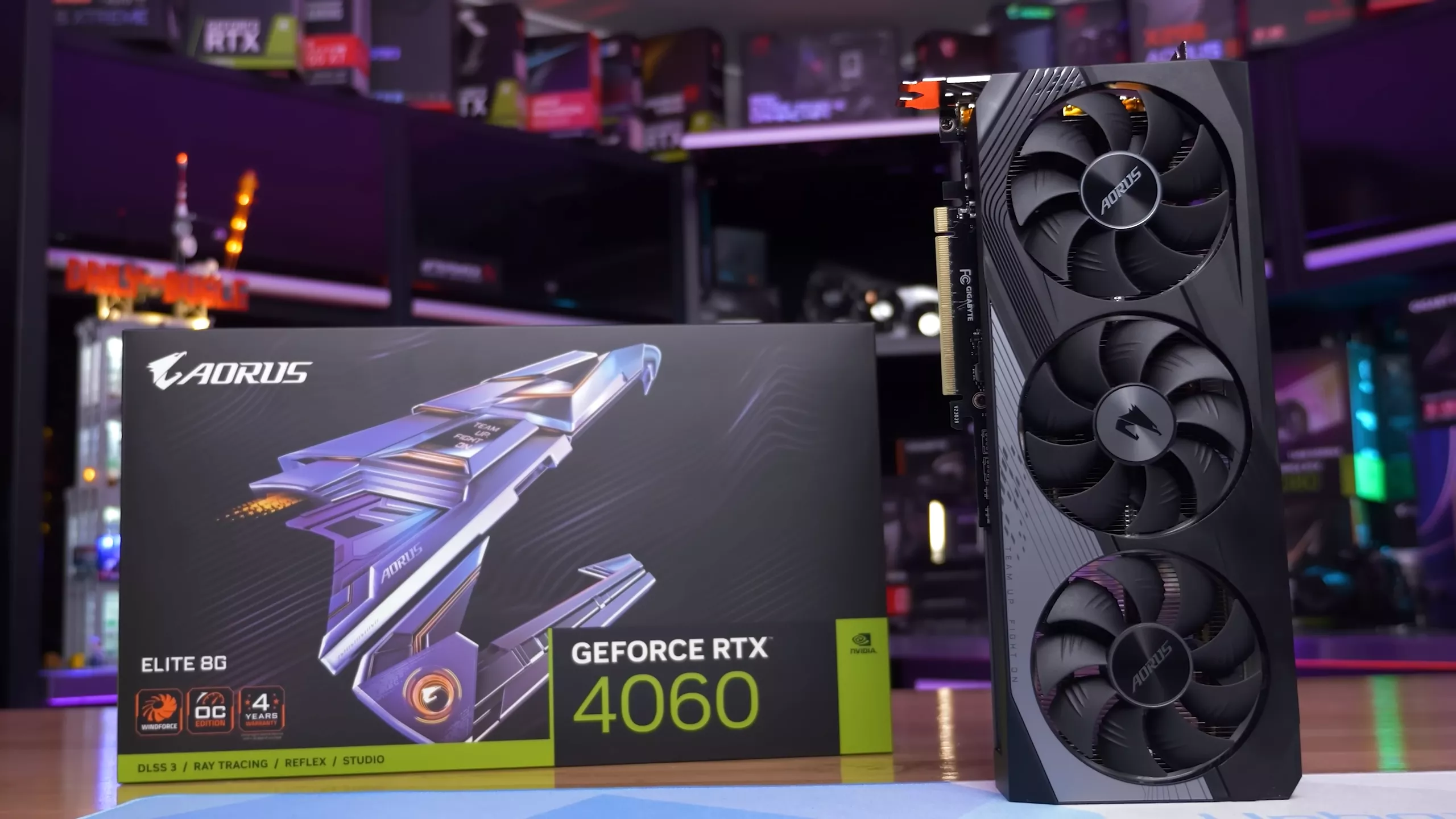
The matchup between the Radeon RX 7600 and GeForce RTX 4060 is much simpler – and it highlights how little real competition there’s been in this segment, arguably since the days of the RX 580. At the time, AMD’s FSR upscaling was miles behind Nvidia’s DLSS, and while ray tracing was technically present on the 4060, its performance was so underwhelming that it was almost irrelevant. Still, DLSS was a meaningful advantage, and AMD’s meager $30 discount – about a 10% difference – wasn’t enough to sway most buyers.
And it showed. Aside from that slight price cut, the RX 7600 offered nothing Nvidia didn’t. Both cards came with 8GB of VRAM and similar rasterization performance, with AMD usually a hair slower. That generation wasn’t a complete step backward, but it underscored just how stagnant the budget gaming space had become.
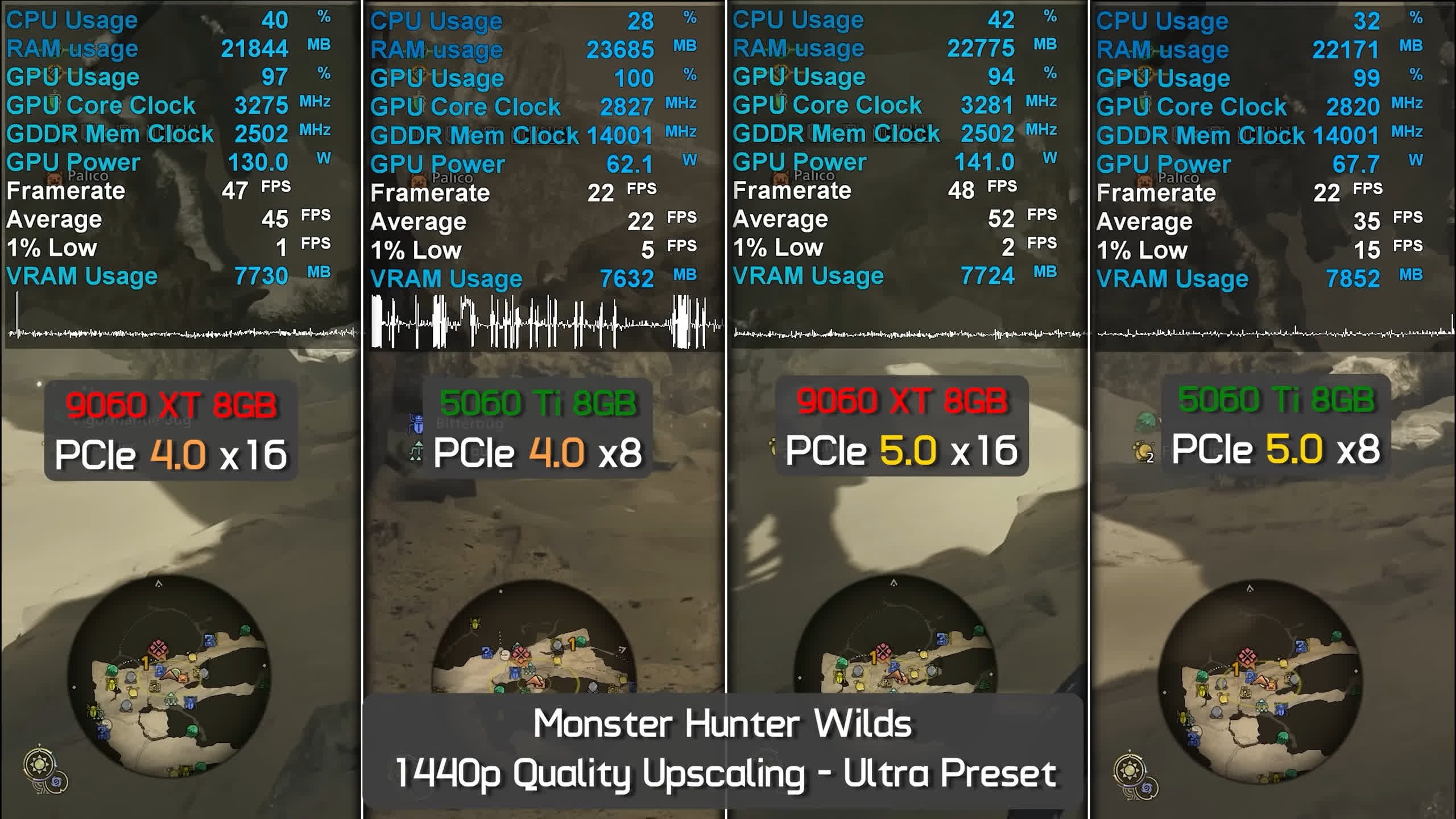
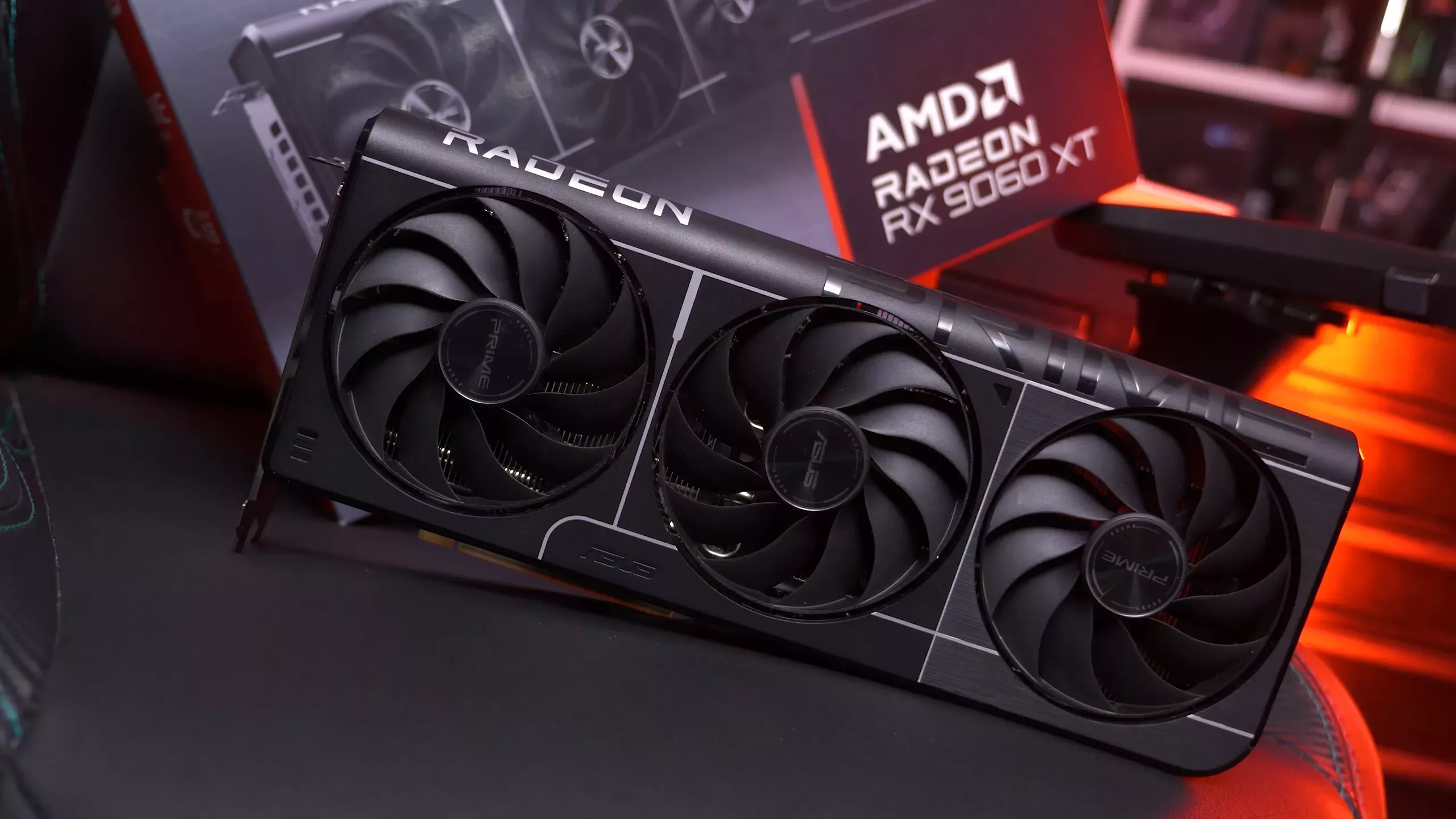
This latest round feels different. AMD has finally given gamers a real reason to buy Radeon. No one’s thrilled to see 8GB GPUs still being sold in 2025, and we recommend avoiding them when possible. But if you have exactly $300 to spend, there’s no better value right now than the Radeon 9060 XT. Better yet, while the MSRP is set at $300, plenty of models are already selling for $270 to $280.
By comparison, Nvidia’s RTX 5060 usually sells at its full $300 MSRP despite being slower and limited to just 8 PCIe lanes. the 9060 XT 8GB the clear winner and without question the best option for $300 or less.
As we wrapped up testing for this review, we spotted RTX 5060 Ti 8GB models dropping to around $340 – still a 25% premium over discounted 9060 XT cards and, like the standard 5060, still stuck with only 8 PCIe lanes. The 16GB version of the 5060 Ti is a stronger product, but it starts at $430. AMD’s 16GB 9060 XT, at $380, probably makes for the better buy, though the case could be made for either depending on your needs.
So here we are in 2025: the best $300 GPU you can buy still only has 8GB of VRAM – and surprisingly, for the first time in years, that card is a Radeon.
Shopping Shortcuts:
First Appeared on
Source link